
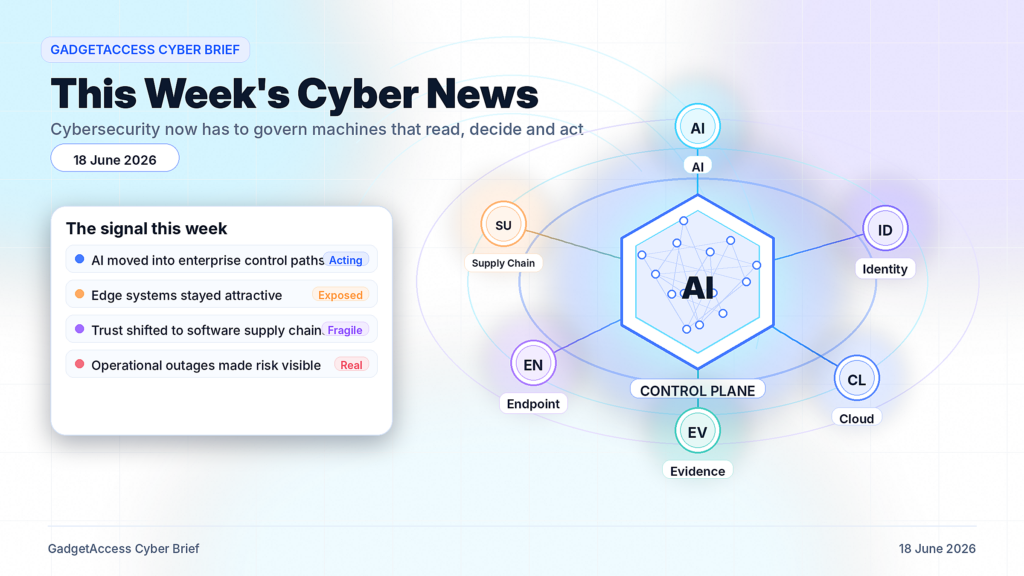
This Week’s Cyber News: The Week AI Joined the Control Plane
Published: 18 June 2026
Edition: GadgetAccess Cyber Brief
Theme: Cybersecurity now has to govern machines that can read, decide and act.
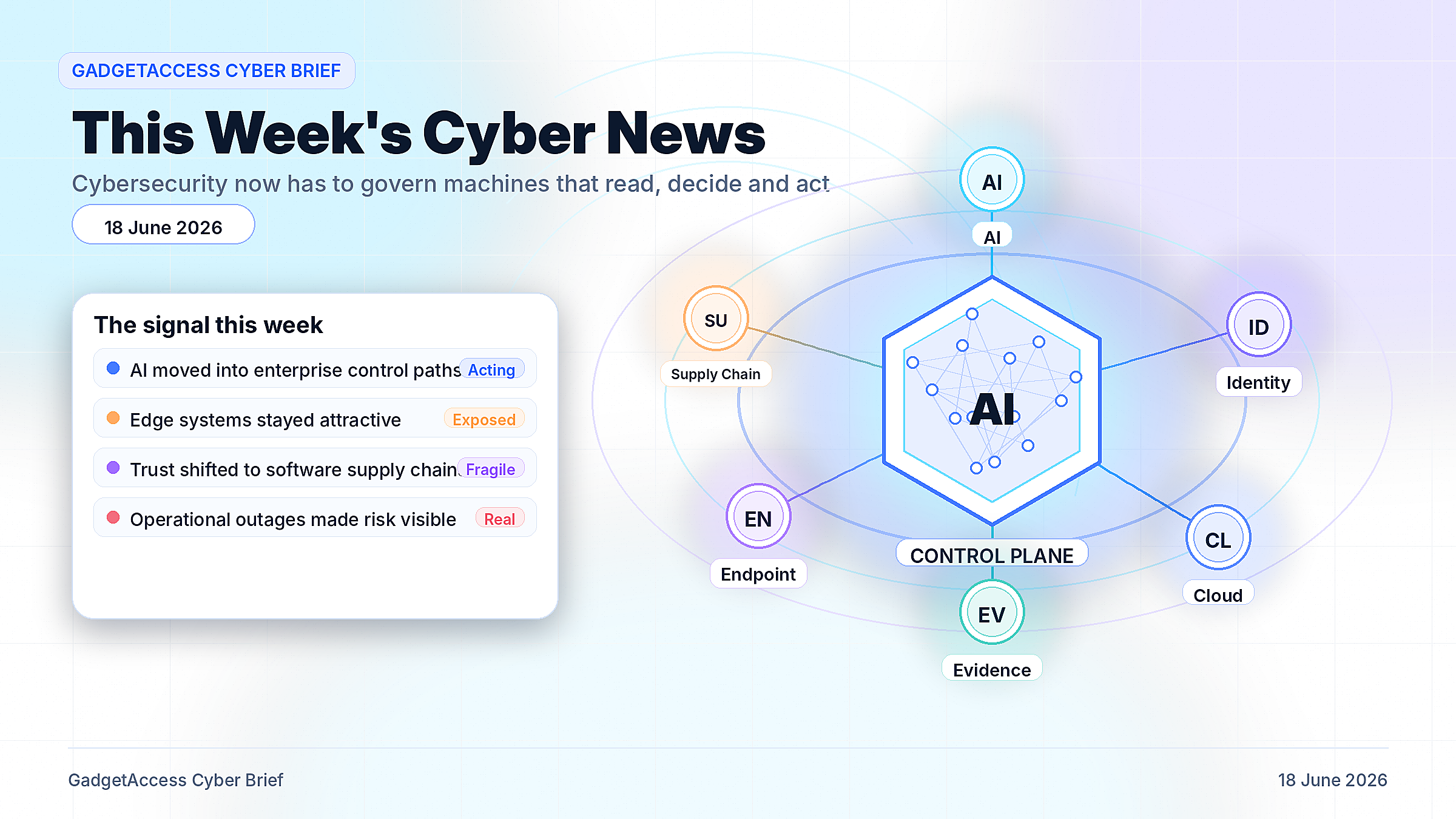
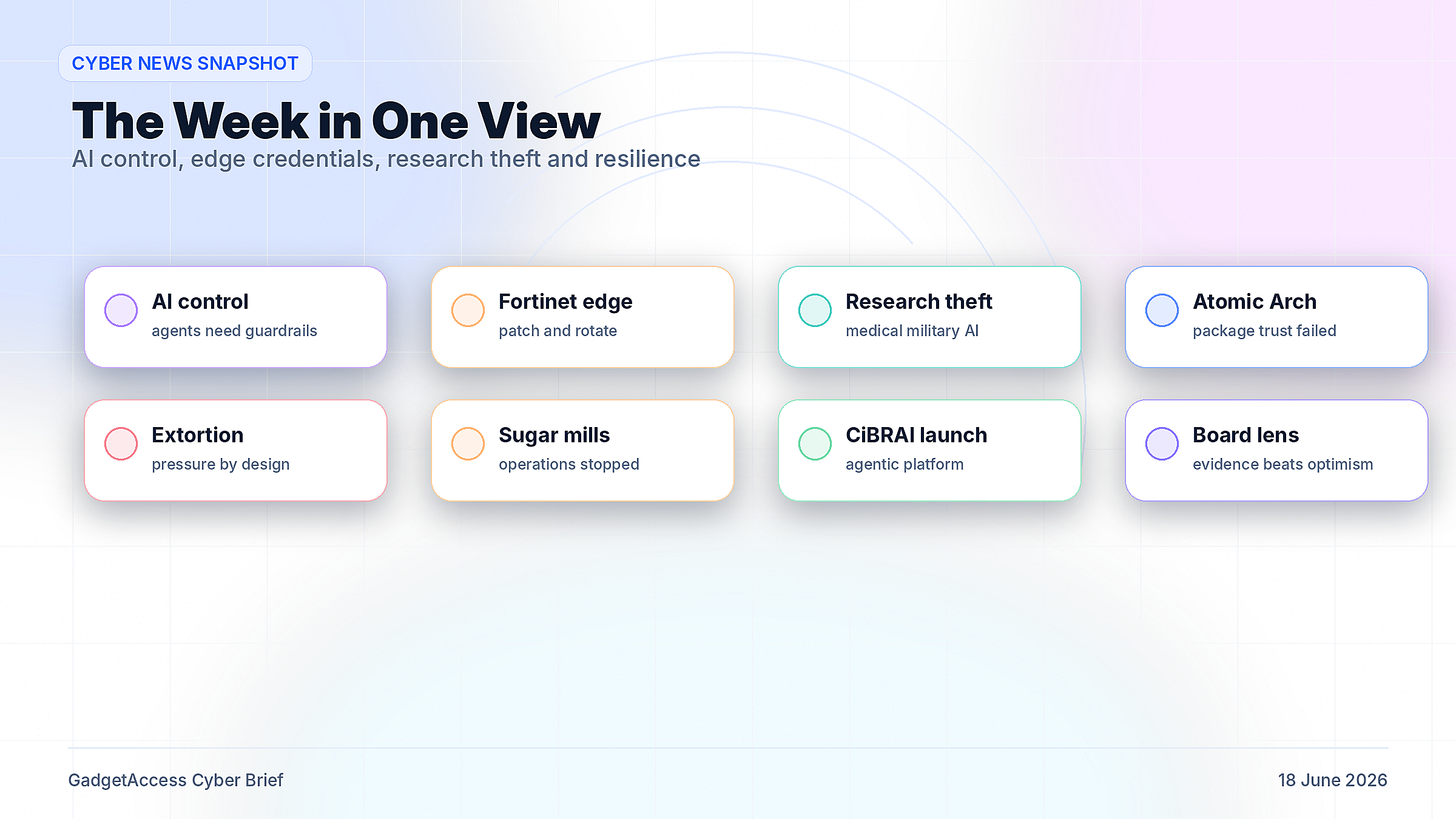
Every so often, a cyber week tells on itself. This one did. AI models generated safety arguments. AI developer tools and gateways looked suspiciously like ordinary software, complete with ordinary flaws and extraordinary blast radius. Research organisations attracted espionage attention. Fortinet devices dragged credential hygiene back into the spotlight. An open source repository reminded everyone that abandoned packages are rarely abandoned by attackers. A sugar producer in Queensland showed, again, that cyber risk eventually becomes operational risk.
The connecting thread is trust moving faster than governance. We are giving tools more access, giving agents more authority, giving packages more build-time power and giving ageing infrastructure more excuses. Attackers do not need to be infinitely clever when defenders keep leaving useful permission lying around like office biscuits.
For GadgetAccess readers, the useful question is not simply what happened. It is what this week says about the operating model we should be building. The answer is blunt: cyber programs now need to manage identity, evidence, software supply chain, operational resilience and AI autonomy as one joined-up discipline. Anything less will feel efficient until the incident starts.
The week in one table
| Story | What happened | Why it matters |
|---|---|---|
| AI safety moved from model chat to enterprise control | Anthropic disputed a claimed Fable 5 jailbreak while the wider market debated model access, guardrails and whether AI systems can be trusted in sensitive contexts. | Safe AI is not a launch badge. It is a control lifecycle with testing, monitoring, privilege boundaries and evidence. |
| Fortinet devices came back into focus | Recently patched FortiSandbox vulnerabilities attracted attention and a broader Fortinet credential-harvesting story sharpened the message for exposed firewall and VPN estates. | Patching matters, but it does not automatically rotate credentials or prove that prior access has been evicted. |
| UNC6508 targeted high-value research | Chinese-linked espionage activity was reported against medical, military and AI research environments in North America. | Research data is strategic infrastructure. It has scientific value, defence value and model-training value. |
| Atomic Arch hit the AUR ecosystem | More than 1,500 malicious packages were reportedly pushed into the Arch User Repository campaign, prompting defensive action by the community. | Open source trust is not abstract. Package install scripts execute, inherit privilege and can reach developer environments. |
| ShinyHunters claimed a Council of Europe breach | The extortion group claimed it stole nearly 300 GB of data and threatened publication. | Extortion now targets regulatory pressure, employee anxiety and institutional reputation as much as systems. |
| FulcrumSec claimed Novo Nordisk data theft | The group claimed it stole 1.3 TB from the pharmaceutical giant, following earlier reporting of IT system compromise. | Healthcare and pharmaceutical data carries unique extortion value because it blends personal, commercial and research sensitivity. |
| Mackay Sugar halted two mills | Operations at the Farleigh and Racecourse mills were stopped after a cyber incident, later claimed by a ransomware group. | Operational continuity is the part of cyber risk everyone understands when the plant stops. |
| Cyber AI tooling showed familiar weakness | Vertex AI SDK, LiteLLM and agentic coding stories all pointed to the same problem: AI systems are still software systems with identity, dependency and execution risks. | AI security cannot sit in a novelty box. It belongs inside ordinary cyber governance, only with stricter assumptions. |
1. AI is not an add-on. It is now part of the attack surface.
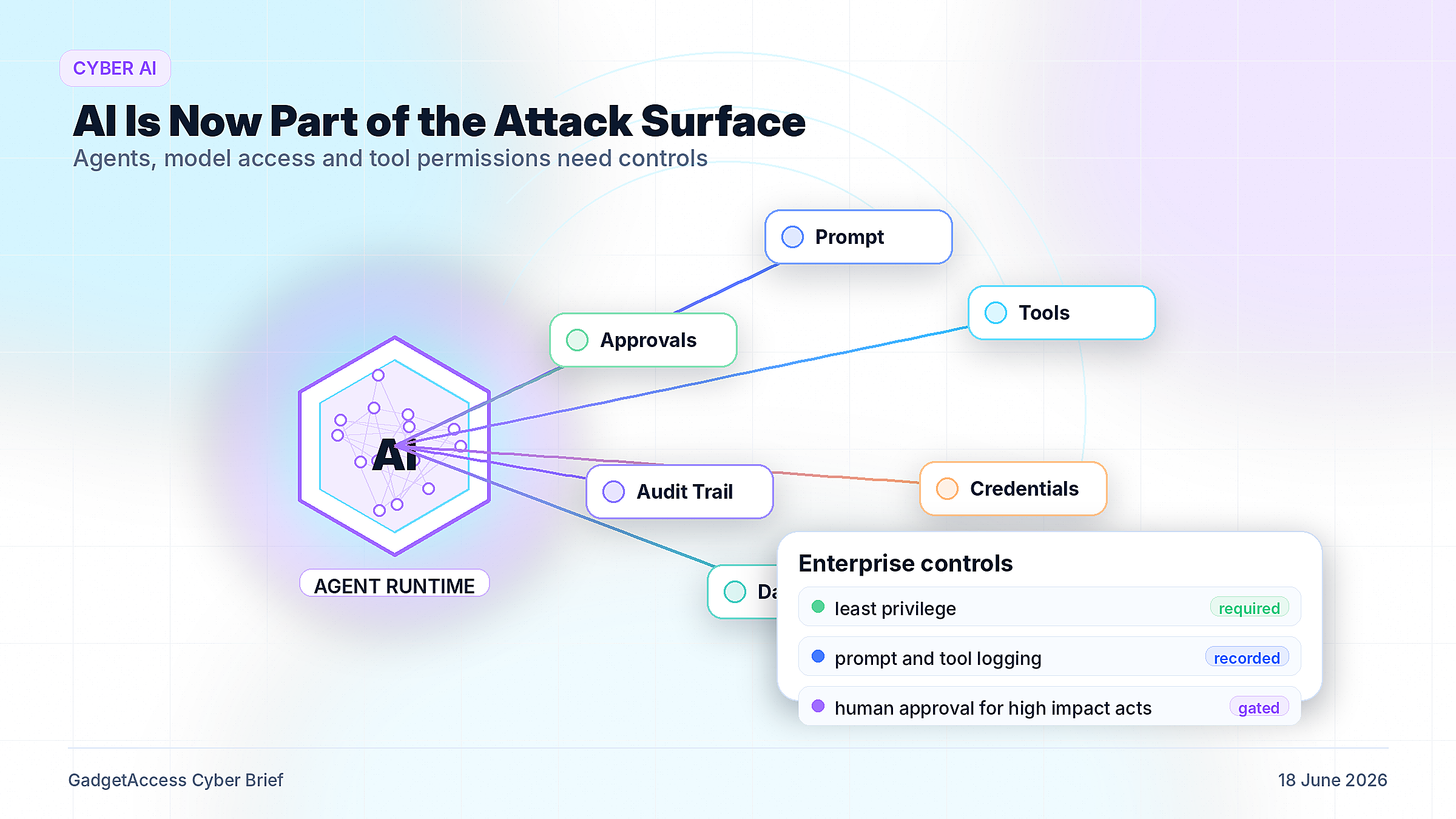
The most interesting AI news this week was not one single model, one single exploit or one single vendor statement. It was the shape of the argument. A claimed Fable 5 jailbreak was disputed by Anthropic. AI model access became a policy and national security talking point. AI gateways and developer agents appeared in vulnerability stories that sounded less like science fiction and more like the last twenty years of application security with a faster narrator.
That is the mature lesson. AI risk is not magically separate from cyber risk. Agentic systems have prompts, tools, memory, credentials, logs, approval paths, API calls and humans who trust their output when the interface looks polished enough. They can be attacked through prompt injection, poisoned context, vulnerable plugins, weak service accounts, excessive permissions and old-fashioned software defects. The novelty is not that attackers suddenly learned to be creative. The novelty is that defenders are attaching creativity to execution rights.
The industry still likes to talk about AI in dramatic terms: jailbreaks, autonomy, superhuman assistance and existential what-ifs. Those conversations have their place. But enterprise security teams need a less cinematic question: what can this agent touch on a bad Tuesday?
That question cuts through the fog. If an agent can read sensitive mail, query customer records, open tickets, run code, change cloud configuration or enrich incidents using internal data, then it needs identity governance. It needs least privilege. It needs human approval thresholds. It needs a clean audit trail. It needs tests that reflect real business use, not merely lab prompts designed to make everyone feel clever.
The practical view is simple. Treat AI agents as non-human identities with an unusually persuasive user interface. Then apply cyber basics with less sentimentality: restrict scope, log actions, isolate tools, monitor behaviour, create rollback paths and require human approval for high-impact changes. The agent may sound calm. That does not mean it should be allowed to update production before coffee.
2. Fortinet reminded everyone that patching is only half the sentence.
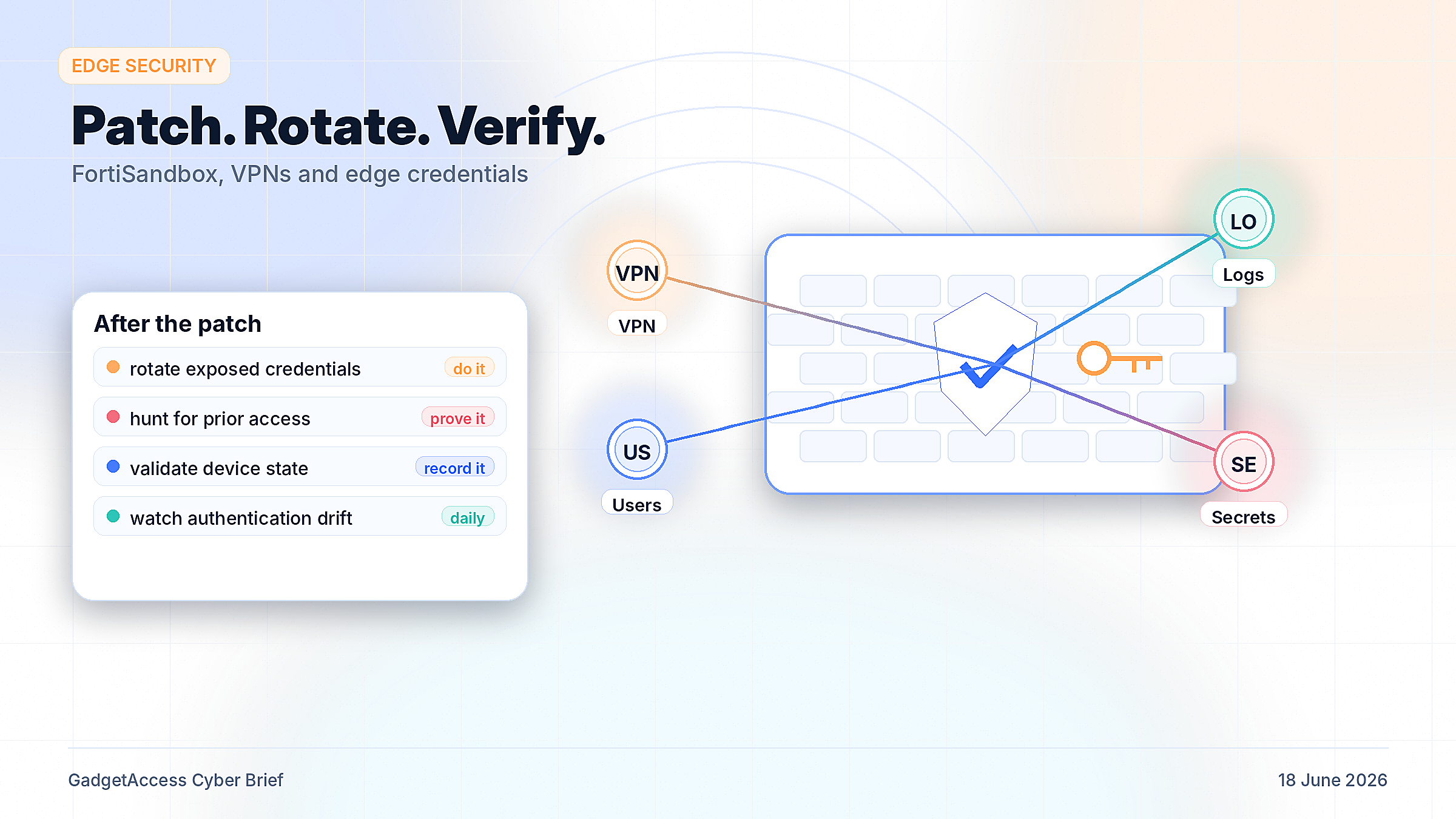
Fortinet appeared in the news twice in the way security teams dislike most: recently patched FortiSandbox vulnerabilities attracting attention, and a wider Fortinet firewall and VPN credential-harvesting story that put exposed appliances back under the microscope. This is not an argument that any one vendor is uniquely fragile. It is a reminder that security appliances are high-value infrastructure because they sit exactly where attackers want to be.
A firewall, VPN gateway or sandbox is not just a product. It is a trust concentrator. It sees traffic, authenticates users, brokers access and often has administrative integration into the rest of the environment. If such a device is vulnerable, exposed or backed by stale credentials, the blast radius can be ugly. If prior credential material is in circulation, a patch alone may provide less comfort than the change record suggests.
The correct response is operational rather than theatrical. Maintain an authoritative inventory of internet-facing security appliances. Confirm patch status against exposure, not against procurement records. Rotate administrative and VPN credentials when there is credible exposure. Review authentication logs, failed attempts, unusual geographies, new local users, changed policies and suspicious forwarding or tunnelling behaviour. Validate that backups and golden configurations exist, are recent and can be trusted.
Security leaders should also stop accepting appliance patching as an isolated metric. A better control statement is: we know what is exposed, we know what version it is running, we know which identities can administer it, we know when those credentials were rotated and we have reviewed evidence of whether the device was misused. That is longer than a green dashboard square, but it has the advantage of being useful.
3. Research theft is quiet because quiet works.
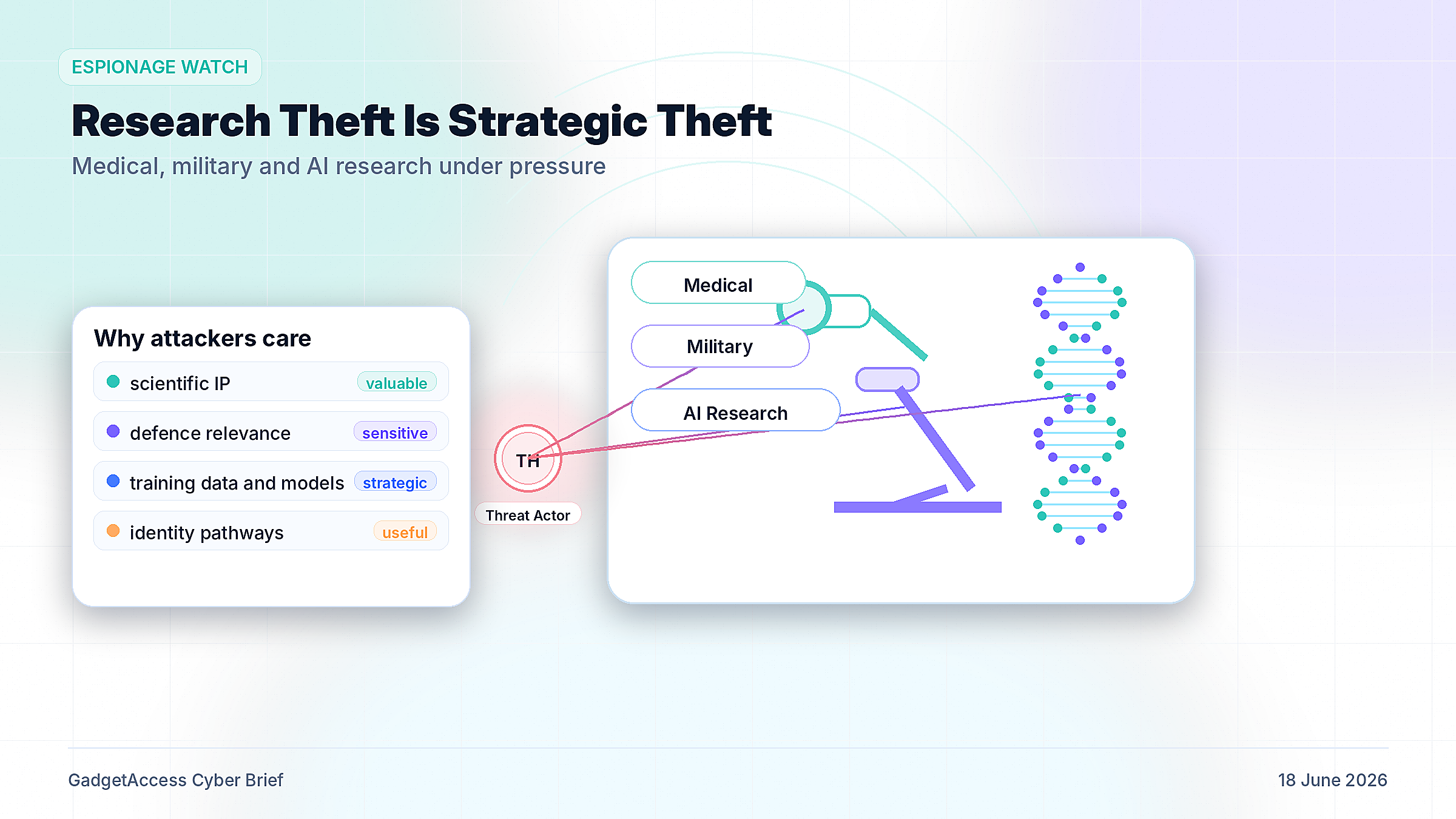
Chinese-linked UNC6508 activity targeting medical, military and AI research in North America fits a pattern that should make executives uncomfortable. The loud cyber stories get attention because ransomware has obvious theatre. Research theft can be more patient. It may not stop production, trigger a ransom note or announce itself with a skull in a browser window. It can simply remove future advantage, one dataset or collaboration account at a time.
Medical research, defence research and AI research are attractive because they sit at the intersection of science, national capability and commercial value. They are also difficult environments to secure. They rely on collaboration. They involve universities, contractors, vendors, labs, cloud platforms, visiting researchers and experimental systems. Access patterns are often messy because the work itself is messy. That is precisely why they are targeted.
The defensive lesson is not to make research environments bureaucratic to the point of uselessness. The lesson is to classify research data by consequence, protect collaboration paths and monitor identity behaviour with the assumption that valuable knowledge may be the target even when production systems are quiet. In plain English: if your AI, clinical or defence research data would be useful to a competitor or foreign service, do not protect it like a shared lunch menu.
This is where cyber governance has to become more curious. Ask which datasets are irreplaceable. Ask which collaborators have access. Ask which cloud projects are tied to which identities. Ask how quickly access is removed when a project ends. Ask whether suspicious data movement would be noticed in hours, days or during the next awkward audit.
4. Atomic Arch showed that abandoned does not mean harmless.
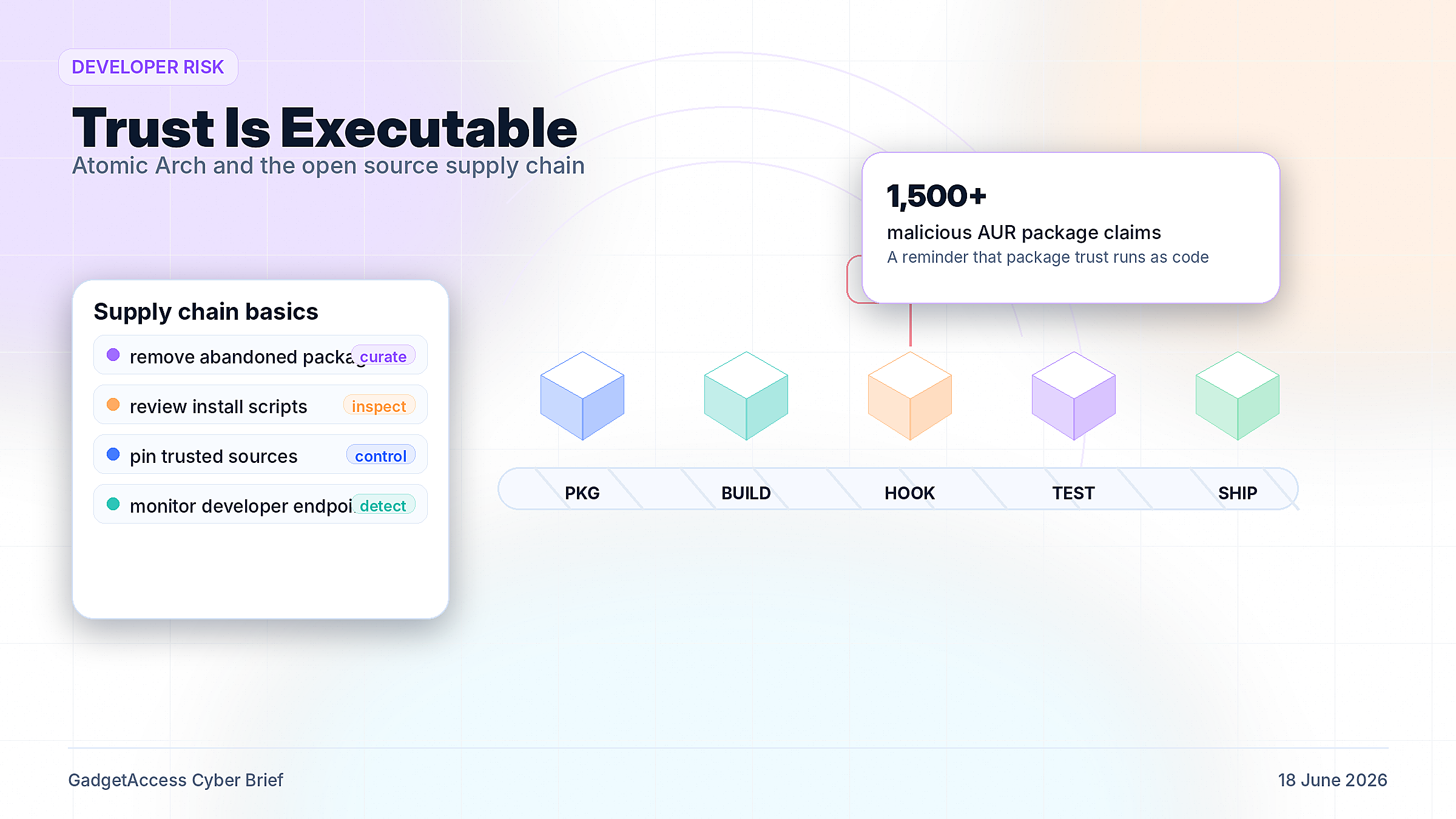
The Atomic Arch supply chain attack against the Arch User Repository is a useful story because it is not exotic. More than 1,500 malicious packages were reportedly pushed as part of the campaign, with the ecosystem taking defensive steps to slow further abuse. The mechanics matter, but the principle matters more: build-time trust is still trust.
Many organisations talk about open source as if it is one thing. It is not. There are mature projects with active maintainers, signed releases and healthy communities. There are also abandoned packages, copycat names, install scripts, helper tools, dependency chains and developer shortcuts held together by optimism and autocomplete. Attackers understand this perfectly.
The software supply chain is now part of the enterprise attack surface because developers are production-adjacent. A compromised package can reach source code, secrets, CI tokens, cloud credentials, local SSH keys and internal documentation. It may not need to exploit a server if the build process happily invites it inside.
A sensible response starts with control over where packages come from and what they can do during installation. Use trusted mirrors and registries where possible. Pin dependencies. Review install scripts. Prefer reproducible builds. Isolate build environments from personal developer machines. Keep secrets out of build contexts. Monitor for unexpected network calls during package installation. Treat abandoned dependencies as inherited risk, not nostalgic software archaeology.
The better executive phrase is not software bill of materials. It is software trust map. The question is not merely what components exist. It is who can change them, how changes are validated and what happens if one turns hostile.
5. Data extortion has become pressure design.
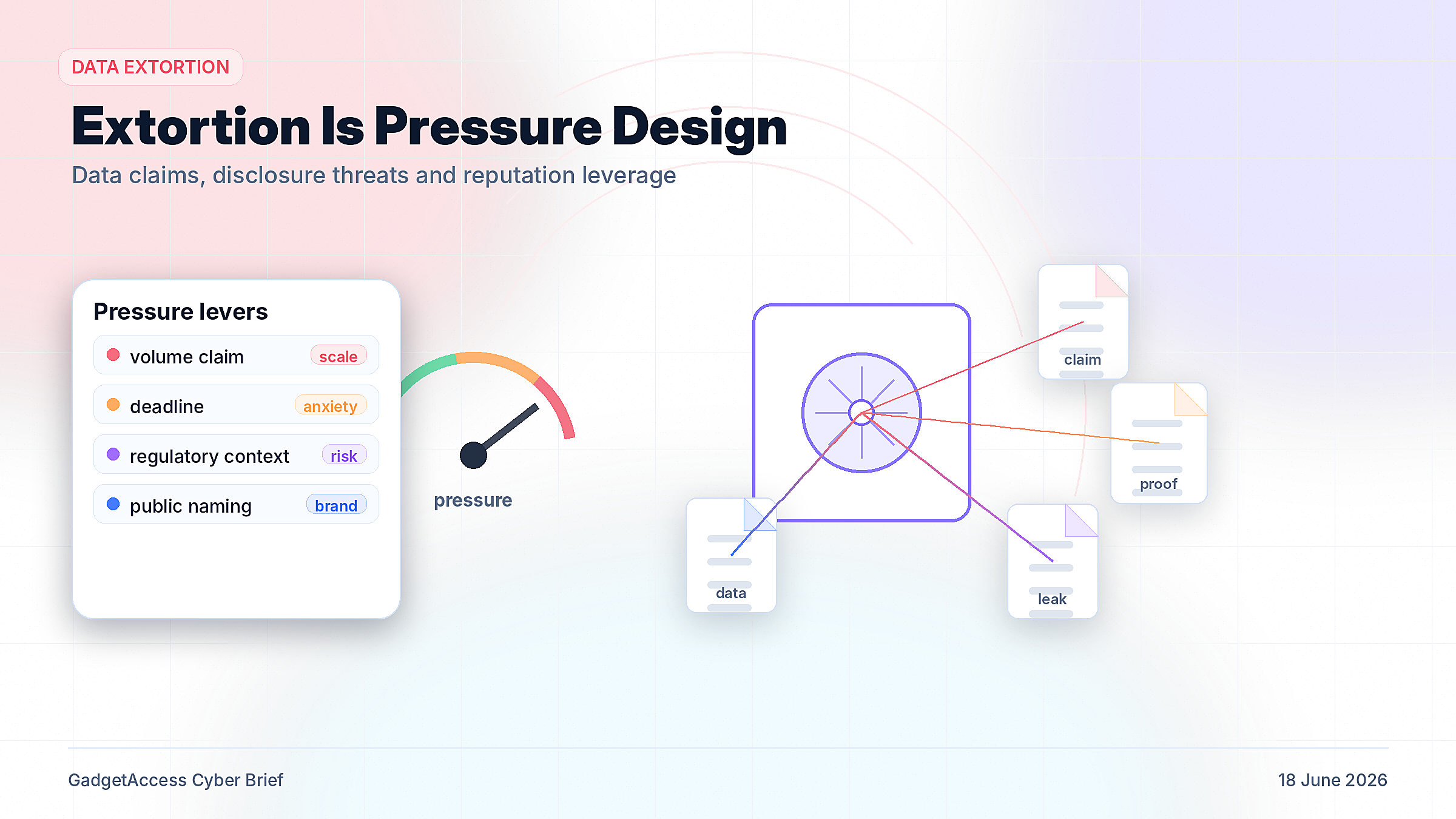
Two claimed breaches this week showed the modern extortion playbook from different angles. ShinyHunters claimed it had stolen nearly 300 GB from the Council of Europe and threatened publication. FulcrumSec claimed it had stolen 1.3 TB from Novo Nordisk, following earlier reports of compromise affecting the pharmaceutical company. Both stories should be handled carefully because claims are not the same as confirmed facts. But the pressure mechanics are obvious.
Attackers increasingly understand that data has emotional, regulatory, strategic and commercial value. HR records can create employee anxiety. Research records can create long-term competitive harm. Healthcare and pharmaceutical records can create privacy, clinical and market sensitivity. Institutional records can create diplomatic and reputational discomfort. The attacker does not need to encrypt everything if the threat of publication creates enough urgency.
This means data classification needs to mature beyond compliance labels. Classify data by extortion value. Which datasets would create the most pressure if published? Which would create the greatest obligation to notify? Which would cause negotiation risk, clinical concern, employee distress, IP loss or media attention? Which would be hardest to explain calmly at 8:15 on a Monday morning?
The response playbook also needs to separate facts from theatre. Validate the claim. Preserve evidence. Confirm data scope. Prepare employee and customer communications. Involve legal, privacy, communications, cyber, executive and business owners early. Avoid letting the attacker become the first person to explain the incident to your stakeholders. That rarely improves the tone.
6. Australia had the clearest business continuity lesson.
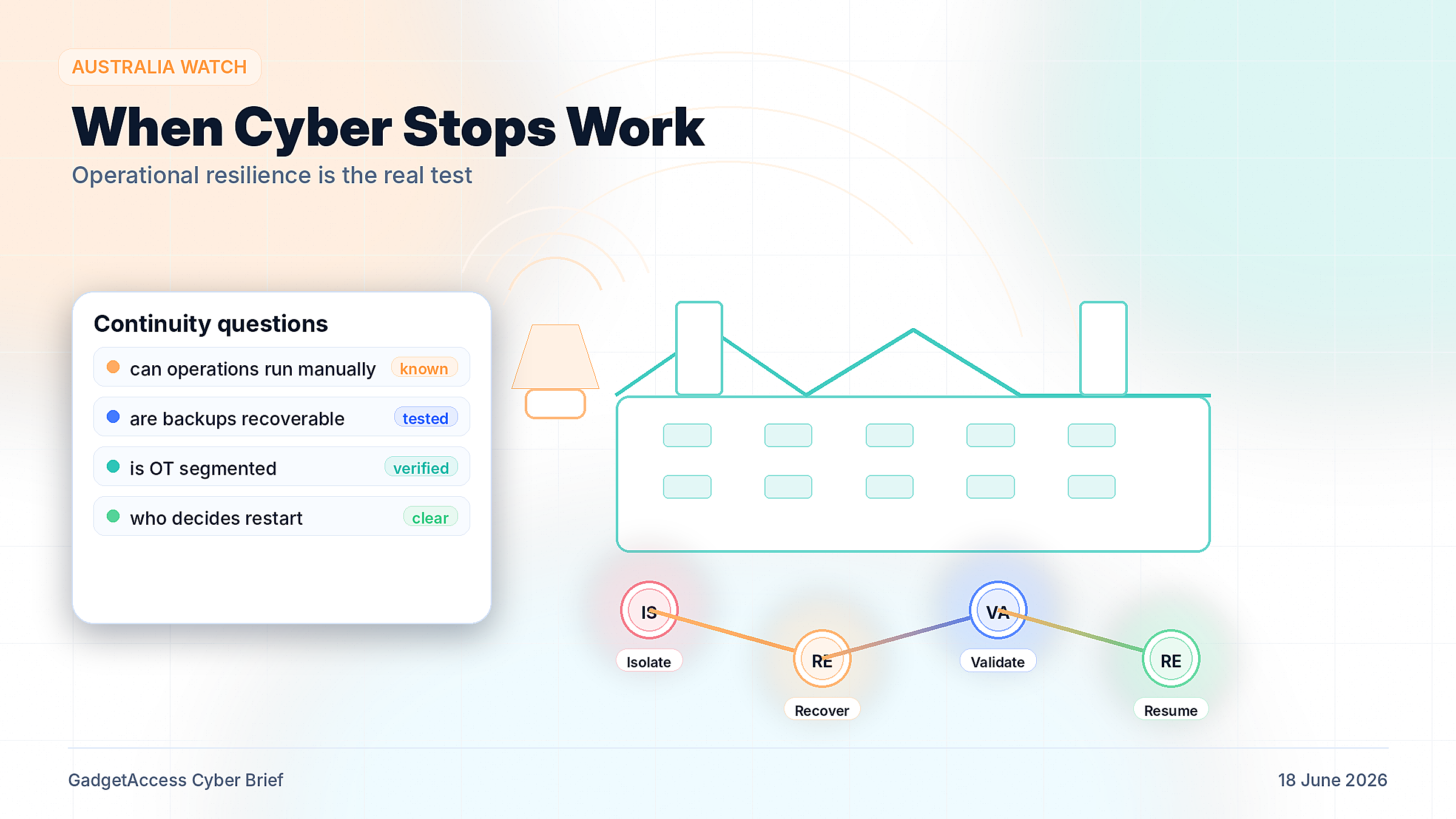
The Mackay Sugar incident cut through the usual cyber abstraction. Operations at the Farleigh and Racecourse mills were halted after a cyber incident, later claimed by a ransomware group. For Australian boards, this is the kind of event that should be discussed without euphemism. When operational systems are affected, cyber risk becomes production risk, safety risk, supply risk, labour risk and community risk at once.
The lesson is not that every organisation should panic about operational technology. Panic is not a control, despite its popularity during steering committee season. The lesson is that recovery planning must be specific enough to survive contact with real operations.
Too many incident response plans still answer the wrong question. They ask whether backups exist. The better question is whether the organisation can restore safely, in the correct sequence, with enough evidence to trust the environment being turned back on. In operational environments, sequence matters. Dependencies matter. Manual workarounds matter. Safety sign-offs matter. The person with authority to restart a system matters.
For Australian businesses, especially those in manufacturing, logistics, agriculture, resources, healthcare and utilities, the practical benchmark should be straightforward: can the organisation maintain critical functions while cyber teams investigate, contain and rebuild? If the answer is a cheerful maybe, that is not resilience. That is optimism with a meeting invite.
7. Agentic cyber operations are useful when they are accountable.
The current agentic AI conversation is finally becoming practical. Australian and allied guidance has been clear in spirit: adopt agentic AI carefully, align it with existing security models, avoid broad or unrestricted access, start with lower-risk tasks and design for oversight, logging, reversibility and least privilege. That is the right tone. It is neither anti-AI nor dazzled by it.
For cyber operations, agentic AI has a credible role. It can correlate alerts, enrich incidents, summarise evidence, suggest response steps, generate executive-ready explanations and reduce the manual stitching that burns analyst time. But the valuable phrase is not artificial intelligence. It is operating discipline. An AI assistant sitting on top of chaotic tools and weak process will not create maturity. It will create faster chaos with nicer paragraphs.
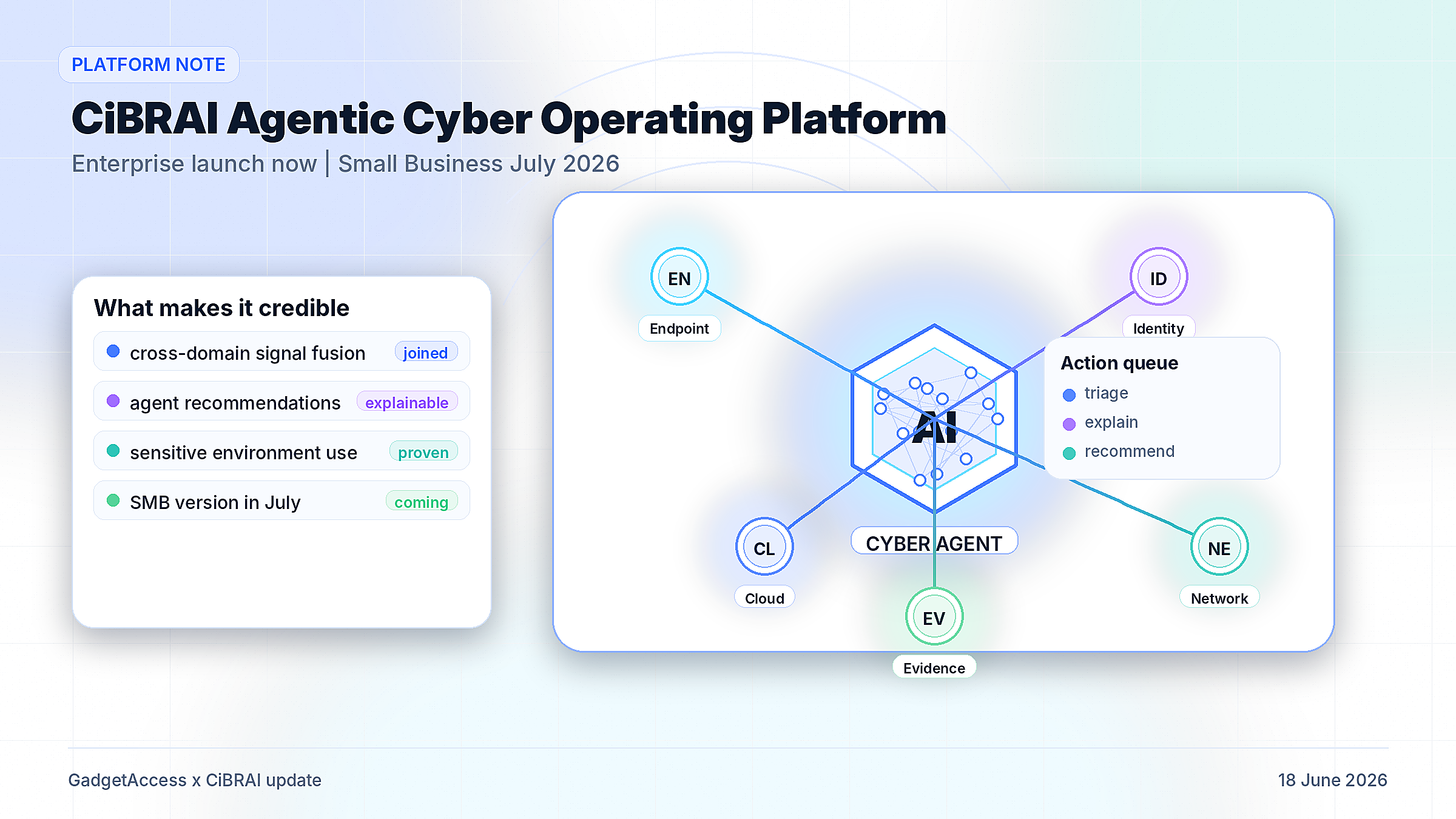
This is why CiBRAI belongs naturally in this week’s discussion. CiBRAI has announced enterprise and small business launches of its Agentic Cyber Operating Platform. The enterprise platform has already been in use in sensitive defence and government areas, and a small business version is due for release in July. Its public positioning is refreshingly operational: bring endpoint, cloud, identity and network signals into one view, use sovereign agentic AI to group events and add context, and prioritise what matters.
That last phrase is doing real work: what matters. Security teams are not short of alerts. They are short of clean decisions. They need to know which incident matters, why it matters, what evidence supports that assessment and which action should happen next. Executives need the same story translated into business consequence without losing the technical truth.
The GadgetAccess view is that agentic cyber platforms will succeed where they make security operations more accountable, not where they merely sound futuristic. The best version of the technology is an always-on analyst layer that helps people move faster while preserving human judgement, clear authority and defensible evidence. The machine can help row the boat. It should not quietly change the destination.
What leaders should ask before next Thursday
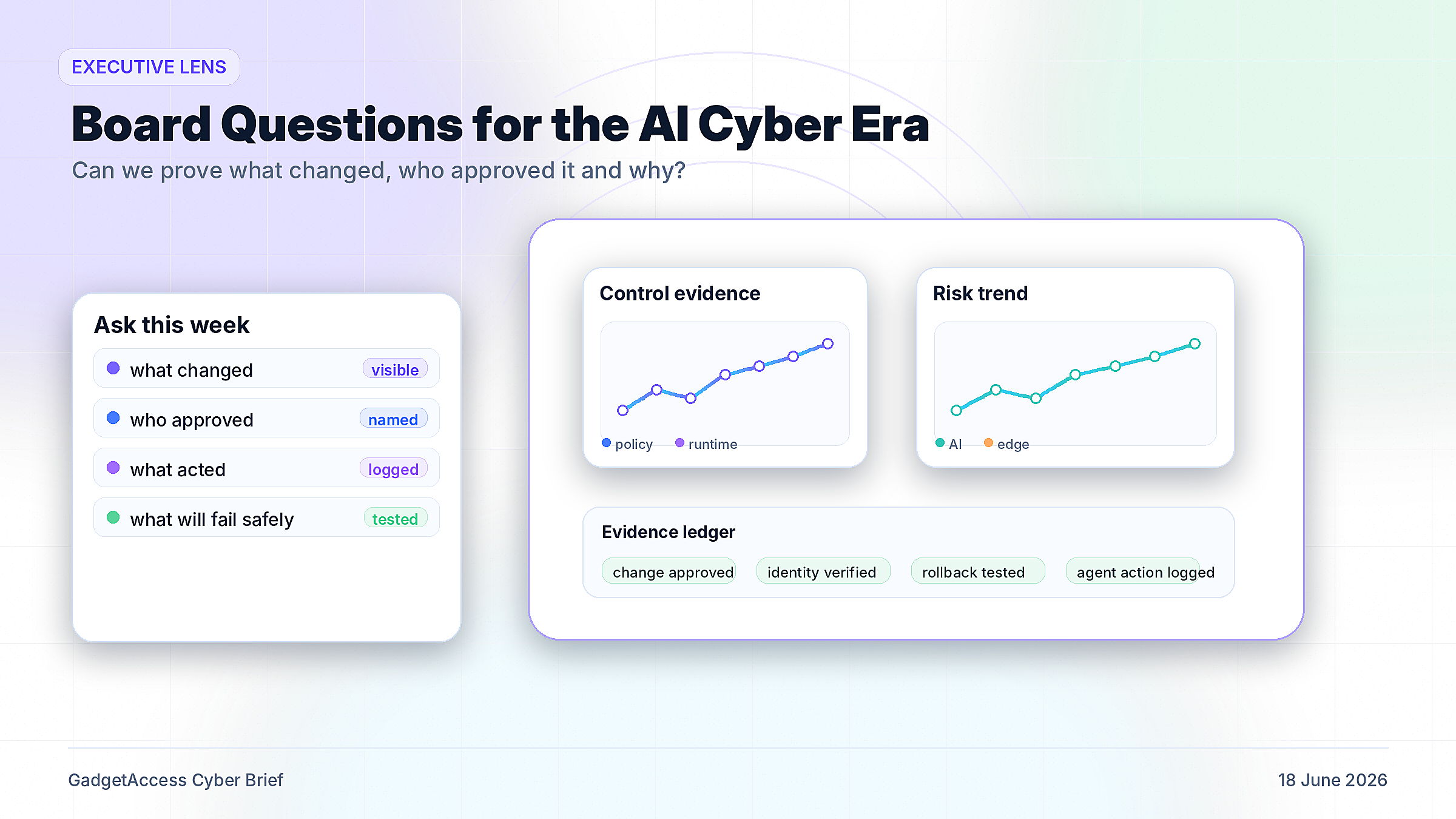
The useful board question has changed. It is no longer enough to ask whether tools exist, whether a policy is approved or whether the dashboard is green. This week suggests a sharper question.
Can we prove what our cyber and AI controls did, when they did it, why they did it and whether the outcome reduced risk?
That question works across the entire week. It applies to Fortinet appliances, AI agents, research access, package repositories, extortion claims and operational recovery. It also has the useful side effect of making vague confidence slightly nervous.
| Area | Ask for this evidence | Why it matters |
|---|---|---|
| Internet-facing appliances | A current exposure inventory, patch status, administrator list, credential rotation record and recent authentication review. | Compromised perimeter devices can become trusted access paths into the organisation. |
| AI tools and agents | Approved use cases, service identities, tool permissions, prompt and action logging, human approval gates and rollback paths. | Autonomous action without clear boundaries turns convenience into risk. |
| Developer environments | Dependency provenance, install script controls, isolated build environments, secrets handling and reproducible build evidence. | The build pipeline is now a front door to production-adjacent trust. |
| Research and high-value data | Data consequence mapping, access reviews, collaboration controls and anomaly detection for unusual download or sharing behaviour. | The most damaging theft may be quiet, patient and strategic. |
| Extortion readiness | A validated data inventory, legal and privacy decision path, stakeholder communications plan and evidence preservation process. | Attackers try to control the story. Preparation helps the organisation regain it. |
| Operational resilience | Manual workarounds, safe restoration sequence, OT dependencies, backup integrity and restart authority. | Recovery must be safe, ordered and trusted, not merely fast. |
| Executive reporting | A decision record showing signal, action, owner, evidence, risk reduction and unresolved uncertainty. | Good reporting should help leaders decide, not merely reassure them. |
Closing thought
This week was not a collection of unrelated cyber stories. It was one story told through different systems: trust is being delegated faster than it is being governed. AI agents are getting tools. Developers are inheriting dependencies. Research teams are collaborating across messy boundaries. Security appliances are concentrating access. Data thieves are learning which records create pressure. Operational businesses are discovering that cyber events do not stay politely inside IT.
The answer is not to slow everything down until the business gives up. The answer is to make trust visible. Know which systems matter. Know which identities can act. Know which data creates consequence. Know which packages can execute. Know which agents can change things. Know which controls produced evidence.
That is the GadgetAccess cyber read for 18 June 2026: less noise, better context, provable action and perhaps one fewer spreadsheet called final-final-v7. We can dream.
About this briefing
The Cyber Brief is a weekly read for senior security leaders, published by GadgetAccess in partnership with CiBRAI. Subscribe to the weekly briefing to get the next edition before it lands here.
If any of this week’s signals raised questions for your environment, we offer a complimentary 30 minute discovery call. No pitch, no follow up unless you ask. Book a discovery call.