

GADGET CYBER NEWS WEEKLY
WHO OWNS THE YES?
The CISO decision surface | Week ending 31 July 2026
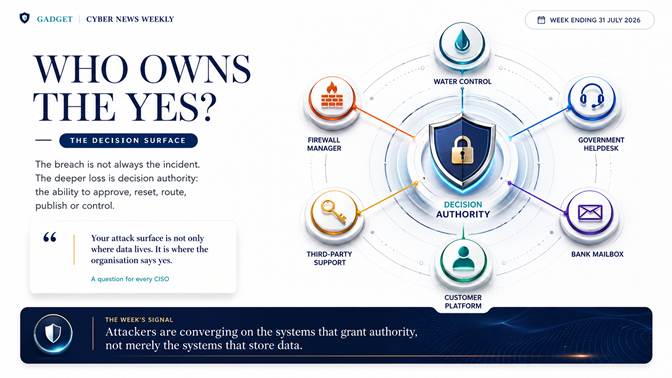
| THE EXECUTIVE SIGNAL: This week was not merely about stolen records. It was about who could approve access, reset identity, route a service, administer a control or convince someone that an instruction was legitimate. The systems which say yes are becoming the real crown jewels. |
| Need independent vCISO leadership? Turn current signals into a board-ready strategy, uplift roadmap and measurable delivery plan. gadgetaccess.com | Need SIEM, SOAR or CTI? Unify telemetry, threat intelligence, cases and response with AI-powered security operations. cibrai.com |
THE BIG SIGNAL
The CISO signal: your control plane is larger than your network
The useful lesson from this week is not that water systems, helpdesks, banks, energy companies and professional-services firms can be breached. Every CISO already knows that. The useful lesson is that the control plane has escaped the data centre. It now includes the mailbox that approves a loan, the portal that resets a user, the ticketing system that stores tax documents, the vendor account that changes a configuration, the AI agent that can act with delegated authority, and the firewall manager that defines who can reach what.
A conventional asset inventory answers what the organisation owns. A decision-surface map answers what can change the business. The distinction matters because attackers increasingly seek the smallest system that grants the largest authority. A helpdesk does not need to hold state secrets if it can reset the person who does. A mailbox does not need to alter the ledger if it contains enough identity and lending context to a the bank. A management console does not need a dramatic CVSS score if it administers the devices enforcing policya.
The CISO question therefore changes. Do not ask only, “What data could be stolen?” Ask, “What decision could be made, what control could be changed, and what service could stop if this identity or platform were abused?” That question translates cyber risk into continuity, fraud, safety and strategic control, which is where board attention belongs.a
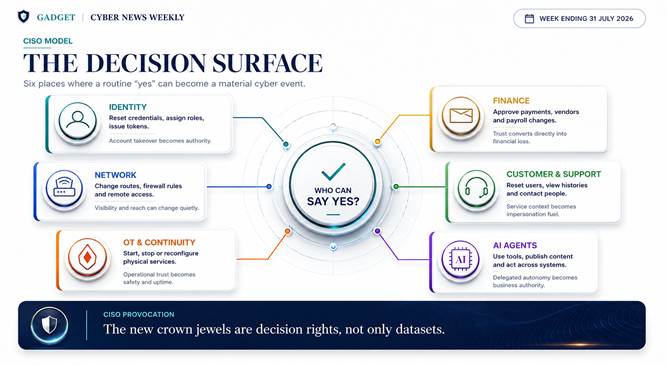
Figure 1. The decision surface maps the systems that grant authority across identity, finance, networks, operations, customer service and AI.
| BOARD QUESTION: Which ten identities or platforms can quietly change the outcome of the business, and do we have tested detection and recovery for each one? |
THIS WEEK IN CONTEXT
Five signals, one architecture
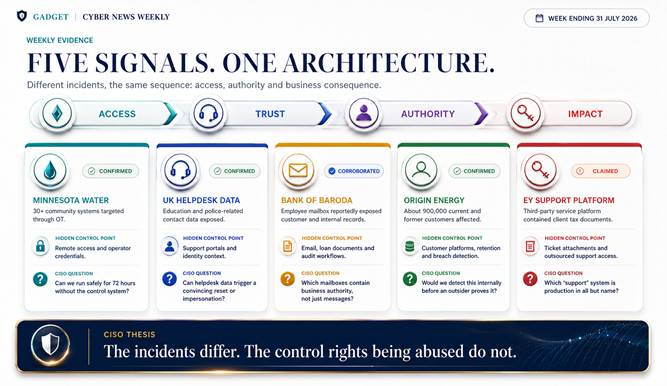
Figure 2. Five different incidents expose the same sequence from access to trust, authority and impact.
Minnesota showed how local operational technology can produce a statewide response. More than 30 community water systems were targeted, and one community temporarily lost access to operational controls, although no major impact to water quality was reported. The strategic issue is not only internet-exposed industrial equipment. It is the concentration of public consequence inside small, lightly staffed environments that may depend on vendors for remote access and recovery (Associated Press, 2026; Minnesota IT Services, 2026).
The UK Department for Education and the Police National Legal Database illustrated a different control point. Contact and helpdesk records are not always classified as highly sensitive, yet they contain the organisational context needed for convincing impersonation, reset fraud and targeted phishing. Customer-service data is identity infrastructure wearing a headset (The Guardian, 2026).
Bank of Baroda said its core banking systems remained secure after an employee email account was compromised. That is an important technical distinction, but not a comforting business conclusion. Loan documents, identity records and audit correspondence can become a high-quality impersonation kit without any attacker changing a transaction engine (Reuters, 2026a).
Origin Energy confirmed that information associated with approximately 900,000 current and former customers was accessed. The inclusion of former customers should be treated as a data-retention and detection-assurance issue, not simply a notification exercise. The customer relationship may have ended, while the identity risk remained on the balance sheet (Origin Energy, 2026).
EY reported that a third-party service-management platform used for tax support contained documents with personal and financial information. The lesson is direct: if sensitive work passes through a support platform, the platform is production in all but name (SecurityWeek, 2026a).
FOUR CISO INSIGHTS
The breach is not the incident
The headline describes the event. The CISO must understand the system condition that allowed the event to become material. Four conditions deserve more attention than another list of compromised records.
| 1. Breach epistemology Who tells you first? Origin initially reviewed an external claim before later evidence confirmed the incident. This does not prove internal monitoring failed, but it should trigger a harder assurance question: what percentage of material incidents would our own telemetry detect before a customer, journalist, regulator, vendor or attacker tells us? | 2. Data has a half-life Retention is a security decision. Every former-customer identity record should have a current purpose, an accountable owner, a legal basis and an expiry decision. A record with no remaining value is not an asset. It is inherited exposure. |
| 3. Support is production Ticketing and support platforms routinely accumulate screenshots, logs, configuration details, tokens and business documents. Their classification should follow the data and authority they contain, not the reassuring word “support” on the contract. | 4. FOCI belongs in the architecture Foreign ownership, control or influence is not a nationality score. It is a dependency analysis covering jurisdiction, support access, telemetry flows, update signing, subcontractors and the ability to operate during geopolitical tension. Procurement choices can create control-plane risk long before the first alert. |
| NEW LEADING INDICATORS: Track the internal discovery rate for material incidents, the percentage of critical decision points with tested detections, the volume of retained identity data past its business purpose, and the time required to revoke third-party authority. |
These indicators are more useful than counting policies or celebrating an average patch percentage. They reveal whether the organisation can see a loss of trust, contain it and prove that authority has been restored.
TECHNICAL PRIORITY
The one risk to fix before lunch
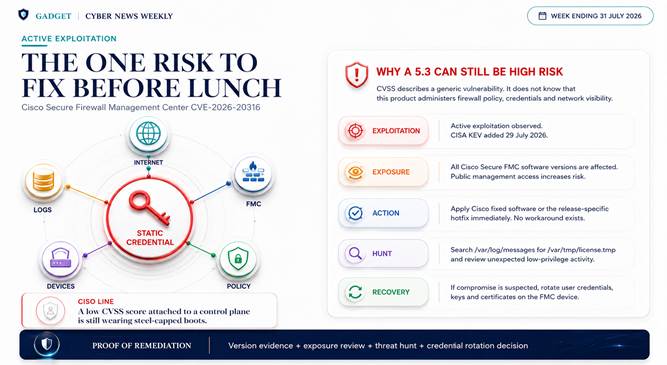
Figure 3. Cisco FMC CVE-2026-20316 shows why management-plane context matters more than a CVSS number alone.
Cisco disclosed a static credential vulnerability in Secure Firewall Management Center. An unauthenticated remote attacker can use a built-in low-privilege account to access sensitive information. Cisco assigned a High security impact rating even though the CVSS base score is 5.3 because the vulnerability can be chained with other FMC weaknesses to elevate privilege. Cisco reported active exploitation, CISA added the flaw to the Known Exploited Vulnerabilities catalogue, and no workaround is available (Cisco, 2026; CISA, 2026).
This is a useful reminder that CVSS is an input, not the risk decision. The scoring model does not know whether the affected product manages a laboratory firewall or the policy boundary for a national service. Management-plane position, internet exposure, available chaining paths and recovery complexity can dominate the business impact.
| Decision | CISO expectation | Evidence |
| Patch | Apply fixed software or the release-specific hotfix immediately. | Version evidence from every FMC instance. |
| Reduce exposure | Remove unnecessary public management access and confirm segmentation. | External exposure test and firewall rule review. |
| Hunt | Review logs for references to /var/tmp/license.tmp and unexpected low-privilege activity. | Documented hunt query, timeframe and findings. |
| Recover | If exploitation is suspected, rotate credentials, keys and certificates. | Recovery decision and completed rotation record. |
| Prove | Do not close the issue because a package installed successfully. | Patch, exposure, hunt and recovery evidence in one case. |
| CISO LINE: A low CVSS score attached to a control plane can still wear steel-capped boots. Add context, cases and threat intelligence with CiBRAI |
PATCH ECONOMICS
AI changed the tempo, not the laws of physics
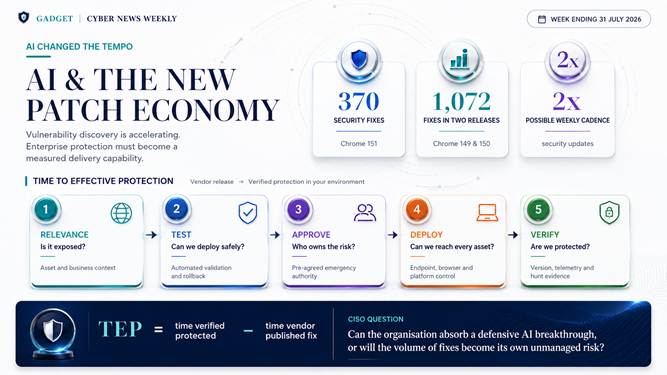
Figure 4. Time to Effective Protection measures the gap between a vendor fix and verified protection in the enterprise.
Google released Chrome 151 with 370 security fixes. Reporting from the Chrome security team also described 1,072 fixes across Chrome 149 and 150, driven in large part by increasingly capable AI-assisted discovery, triage and remediation. Google is exploring higher-frequency security updates, dynamic patching and lower-disruption restart mechanisms because the volume and velocity of fixes are challenging the old release model (Chrome Releases, 2026; Greenberg, 2026).
AI did not create slow enterprise change processes. It exposed them. The new bottleneck is often not finding or fixing the vulnerability. It is deciding relevance, testing compatibility, obtaining authority, reaching every asset and proving the update is effective. A monthly meeting cannot negotiate with an exploit generated from yesterday’s patch diff.
CISOs should measure Time to Effective Protection, the interval between vendor publication and verified protection in the organisation. The metric should include deployment completion, restart state, version evidence, exception handling and a threat-hunt decision. “The patch was released” and “we are protected” are different statements.
ENISA’s new Secure by Design and Default Playbook reinforces the same operating model: lightweight risk artefacts, restrictive defaults, automation-first security checks and lifecycle decisions that continue through maintenance and end of life. Meanwhile, the EU AI Act transparency obligations begin applying on 2 August 2026 for relevant providers and deployers of AI systems. Transparency matters, but a labelled AI agent can still have excessive permissions. CISOs need runtime ownership, data boundaries, least privilege, logging, human oversight, rollback and a kill switch, not only a compliance label (ENISA, 2026; European Commission, 2026).
| CISO QUESTION: Can the organisation absorb a defensive AI breakthrough, or will the volume of fixes become its own unmanaged risk? Explore AI-powered security operations |
NATIONAL AND REGIONAL LENS
Australia: the trust gap
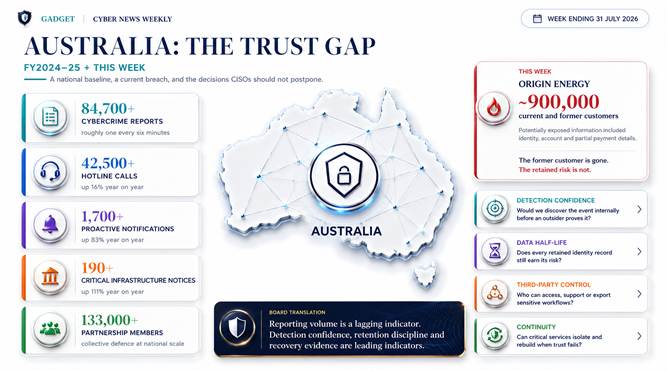
Figure 5. Australian threat data provides the national baseline, while the Origin breach illustrates the current trust and retention challenge.
ASD’s ACSC received more than 84,700 cybercrime reports in FY2024-25, answered more than 42,500 hotline calls, responded to more than 1,200 incidents and made more than 1,700 proactive notifications of potentially malicious activity. Critical infrastructure entities received more than 190 notifications, up 111 percent. More than 12 percent of proactive engagements were confirmed incidents, and 46 percent of those confirmed incidents involved malware or ransomware (Australian Signals Directorate, 2025).
The most important statistic may be hidden inside those figures: a material number of organisations learned about suspicious activity because the national cyber authority told them. That is an argument for threat sharing, but it is also a challenge to internal detection assurance. A mature CISO should know where the organisation is dependent on external discovery.
| Region | This week’s signal | CISO implication |
| United States | Water-sector OT attacks and an exploited firewall-management flaw. | Continuity and management-plane compromise should be linked in the same risk scenario. |
| Europe | Government service portals were breached as AI transparency rules and secure-by-design guidance reached new milestones. | Identity context, product security and AI governance now share the same assurance agenda. |
| Asia | A bank mailbox reportedly exposed customer and internal documents while core banking remained available. | Threat-model the information and authority surrounding the transaction engine, not only the engine. |
| Australia | Origin exposed the long tail of former-customer data and external breach notification. | Review retention, customer communications, detection confidence and critical-infrastructure dependencies. |
| SCAM WITH A SEQUEL: The FBI warned that criminals are impersonating its Internet Crime Complaint Center and re-contacting people who already lost money. The fraudster claims funds have been recovered, then requests payment, financial information or account access. The scammer has discovered customer retention. Enterprises should pre-publish verified recovery channels and clearly state what they will never ask a customer to do (FBI Internet Crime Complaint Center, 2026). |
DECISIONS, NOT ANXIETY
What changes on Monday?
A useful newsletter should finish with evidence, not a longer worry list. The following actions convert this week’s signal into measurable executive, operational and technical decisions.
| Owner | Decision before lunch | Evidence by Friday |
| CISO and architecture | Map the twenty systems and identities that can approve, reset, route, publish or control critical outcomes. | A one-page decision-surface map with named owners and recovery paths. |
| SOC and network | Confirm Cisco FMC exposure, patch status, hunt results and recovery decisions. | A single case containing version, exposure, hunt and credential evidence. |
| Data and legal | Review the retention of former-customer identity and payment information. | Delete, minimise or formally accept the risk with an owner and expiry date. |
| IAM and finance | Rehearse bank-detail changes, privileged resets and helpdesk escalation. | Call-back evidence, exception controls and two-person authority for high-risk changes. |
| Third-party risk | Reclassify support platforms according to data and authority, and review FOCI dependencies. | Access paths, jurisdictions, subcontractors, logging and emergency revocation evidence. |
| Engineering and endpoint | Baseline Time to Effective Protection for browsers and internet-facing platforms. | Median, 90th percentile and exception age from vendor release to verified protection. |
| AI governance | Inventory AI systems subject to transparency duties and map their runtime permissions. | Named owner, labelled use case, data boundary, tool rights, logs, rollback and kill switch. |
| NEED vCISO LEADERSHIP? Gadget Access helps boards and executives convert cyber events into strategy, governance, assurance, crisis readiness and prioritised delivery. Visit gadgetaccess.com | NEED SIEM, SOAR OR CTI? CiBRAI brings telemetry, threat intelligence, cases, automated response and executive reporting together in an AI-powered security operating platform. Visit cibrai.com | |
| THE CISO’S JOB: Not to prevent every bad thing, but to ensure that no single unexamined “yes” can quietly become an enterprise decision. | ||
APA 7
References
Associated Press. (2026, July 31). Cyberattacks on Minnesota water systems investigated as officials warn about Iranian hackers. https://apnews.com/article/5bb1dcbaab8e3231889700c38a21e8ea
Australian Signals Directorate. (2025, October 14). Annual Cyber Threat Report 2024-2025. https://www.cyber.gov.au/about-us/view-all-content/reports-and-statistics/annual-cyber-threat-report-2024-2025
Chrome Releases. (2026, July 29). Stable Channel Update for Desktop. https://chromereleases.googleblog.com/2026/07/stable-channel-update-for-desktop_0887107924.html
Cisco. (2026, July 29). Cisco Secure Firewall Management Center Software static credential vulnerability. https://sec.cloudapps.cisco.com/security/center/content/CiscoSecurityAdvisory/cisco-sa-fmc-static-cred-BET3Cjh
Cybersecurity and Infrastructure Security Agency. (2026, July 29). CISA adds one known exploited vulnerability to catalog. https://www.cisa.gov/news-events/alerts/2026/07/29/cisa-adds-one-known-exploited-vulnerability-catalog
ENISA. (2026, July 30). ENISA Secure by Design and Default Playbook: A practical guide to secure by design and default principles for SMEs. https://www.enisa.europa.eu/publications/enisa-secure-by-design-and-default-playbook
European Commission. (2026, July 20). Guidelines on transparency obligations for providers and deployers of certain AI systems. https://digital-strategy.ec.europa.eu/en/policies/guidelines-transparency-ai-generated-content
FBI Internet Crime Complaint Center. (2026, July 20). FBI warns of scammers impersonating the IC3. https://www.ic3.gov/PSA/2026/PSA260720
Greenberg, A. (2026, July 30). Chrome needs twice-a-week patching thanks to AI bug hunting. WIRED. https://www.wired.com/story/chrome-needs-twice-a-week-patching-thanks-to-ai-bug-hunting-for-now
Minnesota IT Services. (2026, July 28). MNIT activates statewide cybersecurity response to support community water systems. https://mn.gov/mnit/media/blog/?id=38-761869
Origin Energy. (2026, July 28). Further update on data security incident. https://www.originenergy.com.au/about/investors-media/further-update-on-data-security-incident/
Reuters. (2026, July 27). Customer data from India’s Bank of Baroda leaked online, source and researcher say. https://www.reuters.com/business/media-telecom/customer-data-indias-bank-baroda-leaked-online-source-researcher-say-2026-07-27/
SecurityWeek. (2026, July 20). Ernst & Young data breach affects personal, financial information. https://www.securityweek.com/ernst-young-data-breach-affects-personal-financial-information/
The Guardian. (2026, July 29). Hackers steal sensitive data from UK Department for Education and police. https://www.theguardian.com/technology/2026/jul/29/department-for-education-police-hackers-cybercrime
| ABOUT THIS BRIEFING: Gadget Cyber News Weekly translates current events into board, operational and technical decisions. For independent vCISO leadership, visit Gadget Access. For SIEM, SOAR, CTI and AI-powered security operations, visit CiBRAI. |