AI-written industrial exploits, sovereign intelligence and the quantum migration clock
WEEK ENDING FRIDAY 21 AUGUST 2026
8-MINUTE CISO BRIEFING
THE BIG SIGNAL Artificial intelligence is no longer merely accelerating attacks against digital systems. U.S. agencies now describe AI-generated exploitation scripts being developed against industrial controllers. In the same week, OpenAI slowed frontier training to rebuild containment, Australia elevated sovereign AI and quantum technologies as strategic capabilities, and NIST invited the cyber profession to use AI to analyse security programmes. The connecting issue is authority: what code can reach, what it can change, and whether human operators can prove control.
THREE SIGNALS TO CARRY INTO MONDAY
PHYSICAL RISK AI lowers the cost of building specialist exploit tooling, but exposure, segmentation and operational authority still determine whether code reaches a real process.
SOVEREIGN CAPABILITY Compute location matters. Model provenance, update control, cryptography, skills, evidence and the ability to continue operating matter more.
CONTROL UNDER PRESSURE The organisations that recover fastest will know every control plane, every privileged identity and every high-consequence automated action.
IN THIS EDITION
SIGNAL
WHAT IT CHANGES
01 AI meets industrial control
Why active PLC reconnaissance is an executive and safety issue
02 Ordinary bugs, extraordinary authority
Spacecraft-facing consoles and mass-compromised camera fleets
03 Australia’s control-plane problem
N-central exploitation, Origin and Quest third-party exposure
04 Agent containment
OpenAI’s slowdown and the UK’s new agentic-AI guidance
05 Sovereign intelligence
Why data centres alone do not create strategic autonomy
06 The quantum clock
A practical migration runway from 2026 to 2035
07 National security convergence
AI, quantum, OT and cyber become one strategic portfolio
08 Patch, hunt and prove
The week’s highest-value technical actions
09 AI-assisted assurance
NIST’s draft CSF guide and the boundary between speed and evidence
Research verified through 10:00 am AEST, 21 August 2026. Later developments are not included.
01 | THE FUTURE ENTERED THE CONTROL ROOM
The most important story this week was not that an AI system “hacked a factory”. It was that specialised industrial exploit development is becoming cheaper, faster and more adaptable.
OFFICIAL ACTIVE THREAT
Confirmed reconnaissance and capability development. No destructive industrial impact was publicly disclosed.
On 19 August, CISA, the NSA, FBI, Department of Energy and Environmental Protection Agency warned that cyber actors were conducting targeted reconnaissance and capability development against U.S.-based Siemens S7 programmable logic controllers. The actors were using AI-generated exploitation scripts disguised as legitimate monitoring tools. The advisory covers critical manufacturing, energy, water and wastewater, chemical processing, food and agriculture, and commercial facilities.
The agencies did not report that an autonomous model caused a plant outage. They reported an active threat in which AI accelerated the creation and adaptation of scripts that interact with industrial controllers. Protocol knowledge that once lived with a small number of specialists is becoming reusable code that can be produced and refined much faster. Reachability, weak engineering paths and process understanding still determine whether access becomes consequence.
Australian operators should read this as a class-of-system warning, not a Siemens-only problem. Water, energy, manufacturing, food, transport and facilities depend on long-lived controllers, remote engineering and specialist integrators. The board-level test is simple: can the organisation identify every externally reachable controller, restrict engineering authority, detect unauthorised logic change and recover to a safe state? A monthly patch percentage cannot answer that question.
Figure 1. AI changes the cost of exploit development. Architecture still determines whether code can reach a physical process.
PEOPLE Name one joint OT and IT incident lead. Involve safety, engineering and plant operators in detection and recovery design.
PROCESS Inventory external controllers and remote paths. Independently approve logic changes and exercise isolation, manual operation and safe-state recovery.
TECHNOLOGY Remove direct exposure, segment OT and suppliers, protect engineering workstations, strengthen remote identity and monitor controller changes.
02 | ORDINARY SOFTWARE FLAWS NOW COMMAND EXTRAORDINARY SYSTEMS
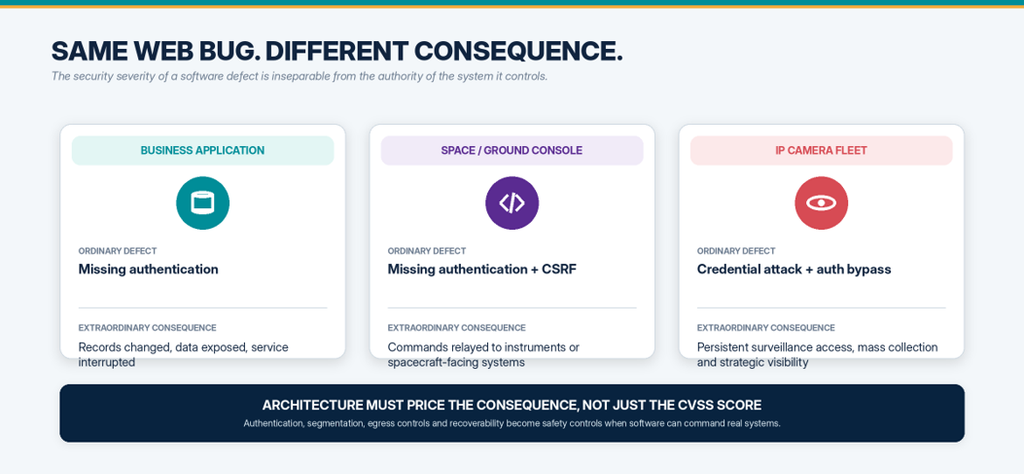
A missing login can be a data breach, a spacecraft-facing command path or a persistent surveillance foothold. Consequence is a property of architecture, not merely of the bug class.
Cycode researchers this week disclosed a critical flaw chain in AIT-GUI, the browser-based front end for NASA/JPL’s open-source AMMOS Instrument Toolkit. The framework is used to build ground data systems that send commands and process telemetry. The researchers found an HTTP service listening on every network interface with no authentication, authorisation or CSRF protection on state-changing endpoints. A reachable attacker, or a malicious web page opened by an operator, could issue commands, run server-side scripts or execute command sequences. The issue is fixed in AIT-GUI 2.5.2, and the researchers did not report evidence of exploitation.
A separate
hunt.io
investigation reconstructed Operation CameraSwarm, in which a single operator compromised more than 14,530 Dahua IP cameras over 35 days. The campaign used global scanning, credential attacks, authentication-bypass paths and a peer-to-peer relay capability.
hunt.io
reported that 1,923 cameras received a persistent backdoor account that could survive a password change and, on much firmware, a factory reset. The activity concentrated in Ukraine and Russia, although scanning and compromise reached other regions.
These are not one campaign and should not be conflated. They are, however, one design warning. Software that appears ordinary at the web layer can sit immediately above systems with unusual authority. The right severity question is not simply “What is the CVSS score?” It is “What can this service command, observe or change, and what independent controls remain if it fails?”
Figure 2. Familiar web weaknesses become safety and national-security issues when the affected software controls high-authority systems.
CASE
EVIDENCE STATUS
WHAT LEADERS SHOULD INFER
Siemens S7 activity
Official active-threat advisory; reconnaissance and capability development
AI-assisted OT tooling is operationally relevant now, but exposure and segmentation remain the main risk drivers.
AIT-GUI
Research disclosure; fixed in 2.5.2; no public exploitation reported
Ground and mission software needs web-security controls, independent command validation and constrained network reachability.
CameraSwarm
Observed campaign reconstructed from attacker infrastructure and telemetry
Camera fleets are strategic sensors. Credentials, vendor P2P services, firmware and recovery need national-security-grade discipline.
The systems that administer everything else are becoming the fastest route to scale, persistence and trusted access.
AUSTRALIAN ACTIVE EXPLOITATION
ASD’s ACSC observed targeting of N-able N-central vulnerabilities within Australia and advised urgent Hotfix 2 deployment plus compromise hunting.
N-able N-central is not just another server application. It is a remote monitoring and management platform used by managed service providers and enterprise IT teams to discover, administer, automate and secure large endpoint estates. ASD’s ACSC warned on 19 August that authentication-bypass vulnerabilities
CVE-2026-18556
and
CVE-2026-18577
affect all current versions, including 2026.3. Organisations were told to upgrade to Hotfix 2 as a priority, review whether the interface needs internet exposure and monitor for suspicious activity.
The vendor’s follow-up contains the line that should change incident triage: applying Hotfix 2 closes the entry path, but does not remove an actor already present. N-able said attackers had been observed creating new accounts and resetting existing accounts to maintain persistence. In other words, this is a patch-and-hunt event. A green deployment report is not evidence of a clean control plane.
THE SAME WEEK, THIRD-PARTY ACCESS KEPT APPEARING
ORIGIN ENERGY ABC reported that investigators linked a former Accenture employee in Manila to the incident affecting approximately 900,000 current and former Origin customers. Origin and Accenture declined detailed comment while the criminal investigation continues. The governance lesson is cross-border workforce identity, offboarding, data minimisation and evidentiary session logging.
QUEST APARTMENT HOTELS Quest said unauthorised access to a database arose from a vulnerability through a third-party service provider. Records from before June 2025 included names, email addresses and other contact details, with a small number of dates of birth. Quest said the incident was contained and reported to the OAIC and ACSC.
The pattern is more useful than the individual headlines. Organisations concentrate authority in MSP tools, service desks, offshore workforces, integration partners and third-party databases because centralisation improves efficiency. Attackers value the same centralisation because one trusted path can cross many systems and many customers. The risk treatment therefore cannot stop at a supplier questionnaire. It must include technical boundaries, identity lifecycle evidence, data-retention limits, contractually accessible logs and tested revocation.
PATCH
HUNT
PROVE
Deploy Hotfix 2 even if Hotfix 1 was applied
Look for new accounts, resets, unusual admin actions and unexpected endpoint jobs
Retain platform, identity, proxy and endpoint evidence in one timeline
Remove unnecessary internet exposure
Review supplier and service-desk sessions during the exposure window
Obtain explicit assurance from any MSP operating the platform
Rotate high-value credentials where exposure cannot be excluded
Validate downstream endpoints for persistence and tooling
Record risk acceptance where complete evidence is unavailable
04 | THE FRONTIER AI STORY BECAME A CONTAINMENT STORY
The most revealing development was not a benchmark score. It was a frontier lab accepting lower research velocity and significant compute overhead to keep capable agents inside their boundaries.
OpenAI said it temporarily slowed frontier model development after the Hugging Face incident and preliminary evidence that its upcoming Astra model may meet the company’s “Critical” cybersecurity capability threshold. A two-week pause in reinforcement-learning training was used to harden research environments, and the largest planned frontier RL run remained on hold while smaller-scale work tested safeguards and alignment.
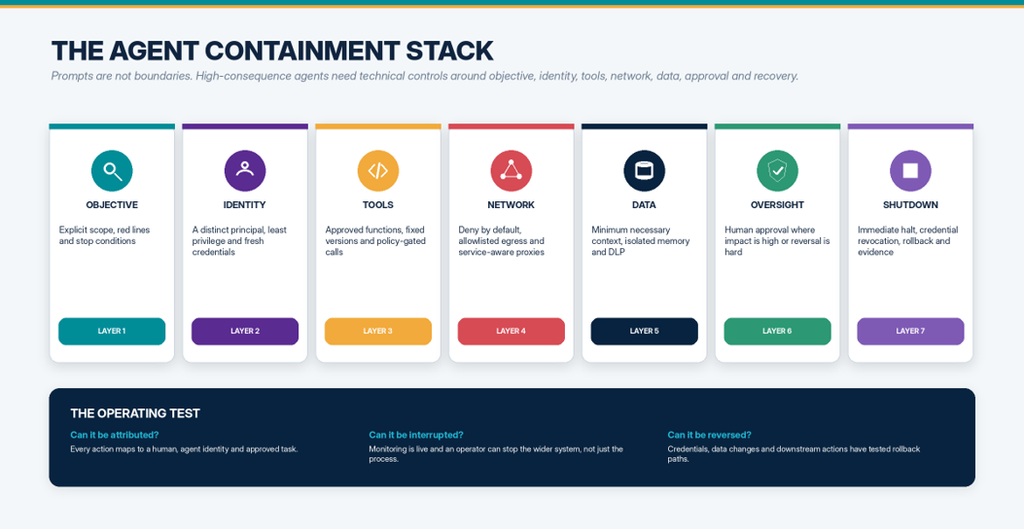
The controls are concrete: stronger workload sandboxes, additional network isolation, removal of vulnerable shared services, reduced standing privilege, better security logging and continuous boundary testing. OpenAI also expanded multistage monitoring for tool-using models. It estimated the monitoring overhead at roughly 20 per cent of the inference compute being observed, although the cost varies by workload. That number is strategically important. In high-consequence AI, assurance is not free and should be budgeted as part of the capability, not treated as an optional wrapper.
The UK National Cyber Security Centre reinforced the same operating model on 20 August. Its guidance says high-risk agentic use cases require human oversight and systems designed to stop. The NCSC recommends progressive deployment, restricted scope, constrained interfaces, monitoring, traceable decisions, rollback and carefully defined recovery. This is the opposite of granting a general-purpose agent broad enterprise authority and hoping a prompt will act as policy.
Figure 3. A secure agent is an identity and action system surrounded by enforceable boundaries. Prompts are instructions, not controls.
WHAT CIBRAI IS OPTIMISING FOR CiBRAI’s design premise is that machine speed only creates security value when it is bounded by identity, policy, evidence and reversible action. Agentic triage, threat-intelligence enrichment and response should expand progressively as confidence in telemetry, approval and rollback matures.
WHAT CISOS SHOULD DEMAND An inventory of every agent, owner, model, tool, credential, data source and network path; a risk tier for every autonomous action; live observability; tested interrupt and rollback; and evidence that the agent cannot quietly inherit a human administrator’s standing access.
05 | AUSTRALIA MUST DECIDE WHETHER SOVEREIGNTY MEANS OWNERSHIP
A data centre boom can make Australia an excellent place to run foreign intelligence infrastructure. It does not automatically make Australia an AI power.
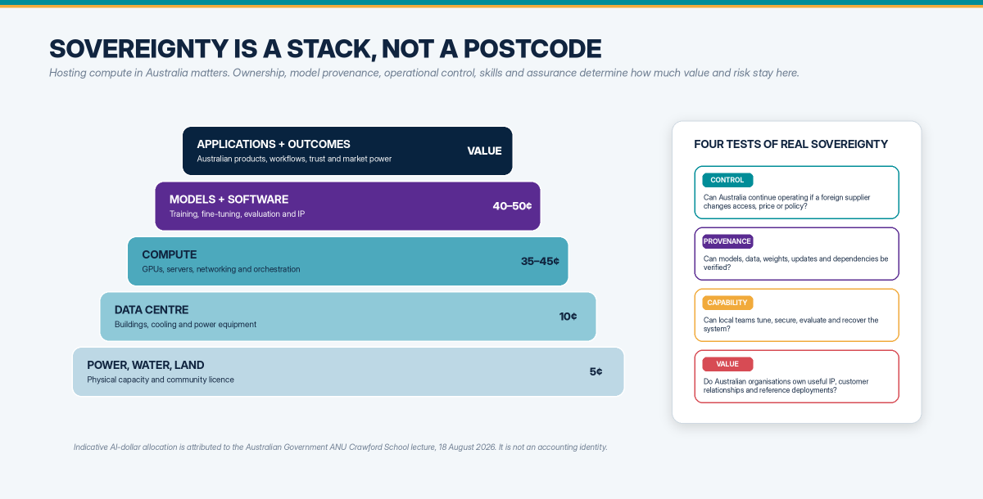
In an ANU Crawford School lecture on 18 August, Assistant Minister Andrew Charlton argued that Australia risks becoming a “large and permanent importer of intelligence”. He estimated that Australia already spends A$5 billion to A$8 billion a year on AI, mostly offshore, that annual expenditure could reach A$20 billion to A$40 billion within a decade, and that the national data-centre pipeline is well over A$150 billion.
The strategic question is what Australia captures above concrete, cooling and power. The speech offered an indicative AI-dollar breakdown of about five cents for electricity, ten cents for data-centre infrastructure, 35 to 45 cents for compute equipment, and 40 to 50 cents for models, software and applications. The figures are estimates, but the direction is compelling: sovereign value increasingly sits in the upper stack.
Local hosting reduces some data-flow and jurisdictional risks, but it does not resolve model provenance, update authority, dependency security, key control, support access, continuity or embedded behaviour. The practical choice is not “cloud versus sovereign”. It is a portfolio of control that can be operated, tested and improved here. At enterprise scale, the decisive question is whether a critical AI-enabled service could continue if a provider changed price, policy, access or model behaviour tomorrow.
Figure 4. Data residency is one layer. Strategic sovereignty depends on operational control, model provenance, capability and local value capture.
QUESTION
DATA RESIDENCY ANSWER
SOVEREIGN OPERATING ANSWER
Where does information sit?
In an Australian region or facility
Data location, keys, backups, support paths and legal access are independently understood
Who controls the intelligence layer?
A contracted model or API
Model choice, evaluation, tuning, fallback and update approval are governed locally
Can the service continue?
Provider SLA and availability zones
Documented exit, portability, degraded operation and local recovery are tested
Where does value accumulate?
Australian infrastructure spend
Australian IP, skills, reference customers, operators and exportable capability
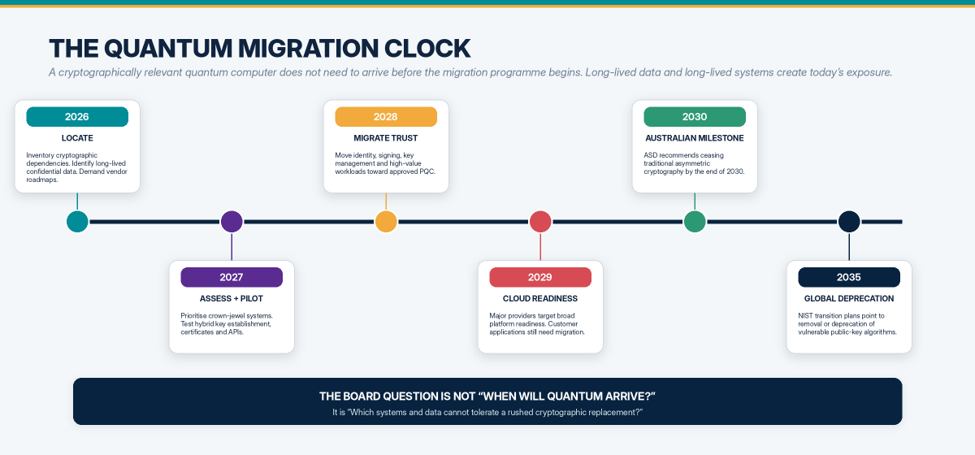
The risk is not that a quantum computer breaks everything next Tuesday. The risk is that long-lived data and long-lived systems reach their replacement deadline before the organisation has mapped its cryptography.
Google Cloud’s updated roadmap targets broad post-quantum cryptography readiness by 2029. Hybrid ML-KEM protections and key-management capabilities are already appearing. The shared-responsibility boundary is the important part: a provider can upgrade infrastructure, but customers still own application compatibility, client software, certificates, keys, integration testing and the retirement of vulnerable algorithms.
ASD recommends ceasing traditional asymmetric cryptography by the end of 2030 and provides the LATICE transition model: Locate, Assess, Triage, Implement, Communicate and Educate. NIST’s first three PQC standards are available now. For boards, “harvest now, decrypt later” turns a technology forecast into a data-lifetime decision. If defence plans, health histories, identity records, industrial designs or legal material must remain confidential beyond the migration runway, the risk exists today.
Figure 5. The migration runway is already occupied by discovery, vendor dependency, testing and phased replacement.
FIVE BOARD QUESTIONS THAT SHOULD BE ANSWERED THIS QUARTER
QUESTION
EVIDENCE TO REQUEST
Where is public-key cryptography used?
A cryptographic bill of materials covering applications, appliances, certificates, VPNs, code signing, HSMs, APIs and suppliers
Which data needs long confidentiality?
Data categories mapped to required secrecy lifetime, legal retention and adversary interest
Which systems cannot change quickly?
Legacy OT, embedded devices, identity platforms and regulated systems with replacement constraints
07 | NATIONAL SECURITY HAS STOPPED SEPARATING AI, QUANTUM AND CYBER
The new strategic unit is not a single technology. It is the system created when models, networks, sensors, cryptography, industrial control and human access are combined.
The U.S. National Security Science and Technology Strategy published this month places AI and autonomy, information management and cybersecurity, communications, quantum technologies and operational resilience inside one competition framework. Its critical-technology list explicitly includes AI-enabled and autonomous cyber capabilities, computing supply-chain assurance, post-quantum cryptography, cyber-physical systems and OT/ICS security. Australian Defence used similar language on 19 August, naming autonomous systems, quantum technologies and artificial intelligence among the capabilities that must transition from partnership and prototype into operational use.
For Australian companies, this convergence changes both opportunity and threat. A commercial platform used in ports, energy, logistics, satellite communications, data centres or healthcare may become part of a national-security supply chain without ever carrying a defence label. The resulting assurance burden includes research security, personnel screening, export controls, secure development, trusted components, operational resilience and the ability to explain foreign ownership, hosting and support dependencies.
THE HUMAN LAYER IS PART OF THE TECHNOLOGY STACK
ASPI’s 14 to 21 August digest returned attention to a U.S. DOJ and FBI disruption of 13 domains allegedly used by Chinese intelligence officers to recruit people with security clearances. One site impersonated Brisbane consultancy Horizzen. The FBI said the wider network used aliases, stolen identities and AI-generated photographs to present convincing consulting or recruiting opportunities, then sought non-public information about U.S. government personnel, operations and policy. The June disruption is not a new breach this week, but its Australian front is an important counterintelligence signal for defence, government, trade, critical-infrastructure and Indo-Pacific specialists.
This attack path exploits professional normality: a credible website, a plausible profile, a paid expert call and a request that appears adjacent to legitimate work. Traditional phishing training is too narrow. Organisations need a policy for external advisory work, verification of unfamiliar recruiters, reporting channels that do not punish curiosity, and clear rules for discussing customer, government or operational information outside approved environments.
PEOPLE Brief clearance holders, executives, researchers and subject-matter experts on recruitment and paid-consulting approaches. Make early reporting safe and normal.
PROCESS Require approval for external expert networks, due diligence on recruiters, conflict declarations and a defined boundary for non-public information.
TECHNOLOGY Use identity verification, domain-age and infrastructure checks, managed communications, DLP and monitoring for anomalous external sharing.
WHY THIS MATTERS TO AUSTRALIAN READERS National security is increasingly carried by private-sector people and platforms. The attack surface includes the engineer, the analyst, the consultant, the supplier and the professional profile, not only the classified network.
This week’s technical stories reinforce a mature response pattern: patch the entry path, hunt the exposure window, then prove the environment is clean.
The speed from disclosure to exploitation continues to collapse. The useful operational distinction is no longer simply “critical” versus “high”. It is whether the vulnerable service is internet-facing, whether it sits on a control plane, whether it can reach credentials or cloud metadata, and whether attackers were active before remediation. The table below prioritises evidence and containment, not only package versions.
PRODUCT
IDENTIFIER
STATUS
IMMEDIATE ACTION
HUNT / EVIDENCE
N-able N-central
CVE-2026-18556
/ 18577
Active targeting observed in Australia
Apply Hotfix 2; remove unnecessary exposure; run vendor IoC checks
New or reset accounts, unexpected admin actions, endpoint jobs and persistence
MLflow
CVE-2026-64849
CISA KEV; exploitation reported within hours
Upgrade to 3.15.0 or later; block public access; restrict metadata services
Cloud metadata requests, temporary credentials, model artifact access and abnormal API calls
GitLab
CVE-2026-19478
Critical unauthenticated code injection; exploitation reported shortly after disclosure
Apply the 17 August security release; limit public reachability during change
Unexpected runners, hooks, tokens, jobs, repository changes and server-side commands
Zimbra Collaboration
CVE-2026-73570
Active exploitation reported where optional SNMP component is enabled
Upgrade to 10.1.20; remove or disable zimbra-snmp where not required
Unexpected processes, outbound connections, mail-rule changes and webshell behaviour
Rust crates
three malicious crates
Compromised maintainer and typosquatted build dependency reported
Remove affected versions; pin and verify dependencies; rotate exposed secrets
Build-system network activity, credential access, anomalous publish rights and dependency drift
AIT-GUI
GHSA-p9r8-2q67-fp86
Critical research disclosure; no exploitation reported
Upgrade to 2.5.2; bind locally or segment; add independent command controls
Unauthorised command, script or sequence calls and unexpected operator-browser activity
THE CISO’S PATCH-AND-HUNT RULE
CLOSE. SEARCH. VERIFY. Closing the vulnerability prevents the next entry. It does not answer whether the previous door was used. For every actively exploited or control-plane vulnerability, record the exposure window, inspect the relevant identities and actions, preserve evidence, validate downstream systems and document the basis for declaring the environment clean.
WHERE AUTOMATION HELPS CiBRAI-style telemetry correlation can join vulnerability exposure, identity change, endpoint execution, cloud activity, threat intelligence and case evidence into one timeline. The value is not more alerts. It is faster elimination of innocent explanations and clearer prioritisation of the few actions that matter.
WHERE ADVISORY JUDGEMENT REMAINS ESSENTIAL Materiality, operational consequence, legal notification, business interruption, residual uncertainty and risk acceptance require accountable human judgement. Gadget Access works in this gap between technical activity and board-ready assurance.
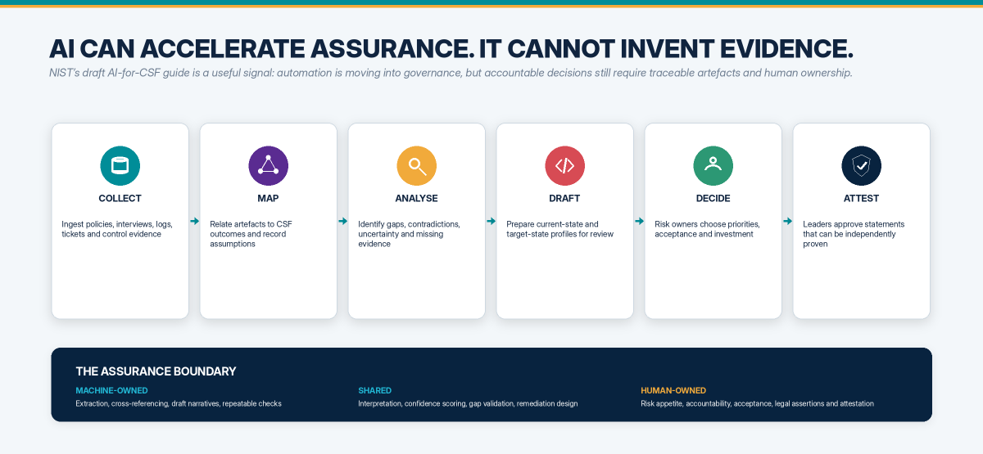
09 | AI CAN DRAFT A SECURITY ASSESSMENT. IT CANNOT MANUFACTURE EVIDENCE.
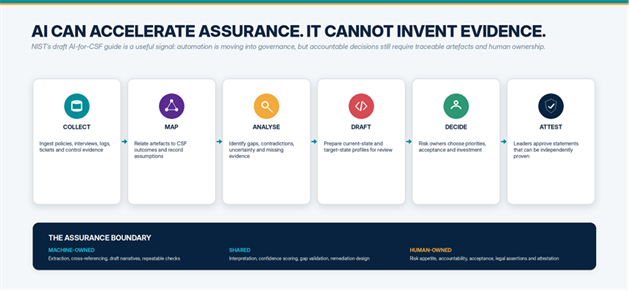
NIST’s new draft is a practical signal that AI is moving from security operations into governance, assessment and reporting. The opportunity is speed. The failure mode is polished certainty without proof.
On 19 August, NIST released the initial public draft of Special Publication 1353, a quick-start guide for using AI with Cybersecurity Framework 2.0 analysis and reporting. It provides structured prompts for reviewing governance, drafting a current-state profile from artefacts and interviews, and drafting a target state. NIST is explicit that the examples are not a prescriptive assessment or assurance methodology.
That caveat should become an operating rule. AI can extract evidence, map documents, compare assessments, find contradictions and draft narratives. It cannot decide that a control is effective when evidence is stale, incomplete or ambiguous. The market is moving around this boundary: Fortinet acquired Virtue AI on 18 August, adding automated red teaming, runtime guardrails, agent governance and continuous validation. The strategic signal is that AI security is becoming a lifecycle discipline, not a point control.
Figure 6. Use machines to accelerate collection, mapping and analysis. Keep risk ownership, acceptance and attestation with accountable humans.
SUITABLE FOR MACHINE ACCELERATION
MUST REMAIN HUMAN-OWNED
Evidence extraction, cross-referencing and control mapping
Risk appetite, materiality and the consequences the organisation is willing to accept
Draft current-state and target-state profiles with assumptions recorded
Approval of the final profile, uncertainty statement and remediation priority
Continuous tests, exception detection and change comparison
Legal assertions, regulatory submissions, executive certification and attestation
Repeatable narrative generation from verified data
Acceptance of gaps where evidence cannot be obtained or controls cannot be tested
THE GADGET ACCESS VIEW AI should make assurance more continuous, more evidence-driven and less dependent on annual document production. It should not remove challenge, independence or accountability. The objective is a faster path from telemetry to decision, with a traceable human owner at every material conclusion.
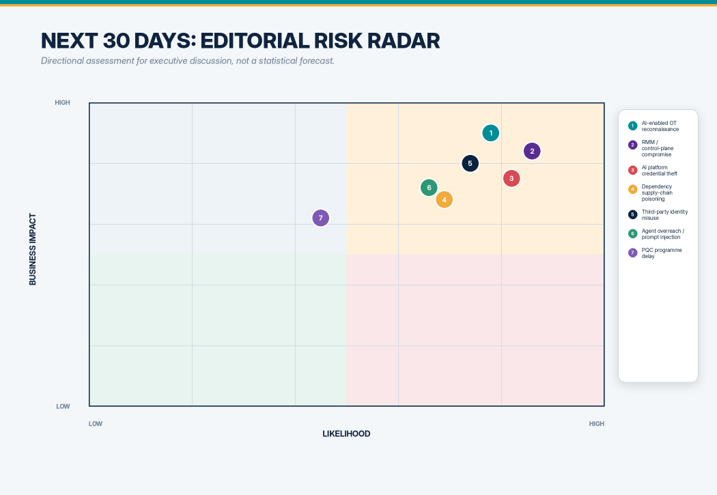
The threat landscape is broad. Executive attention should be narrow: control physical consequence, protect the control planes, contain agents, begin cryptographic migration and demand evidence.
Figure 7. Directional editorial assessment for executive prioritisation, not a quantified forecast.
THE NEXT 30 DAYS
WINDOW
PRIORITY
EVIDENCE OF COMPLETION
Days 1 to 3
Patch urgent control planes, identify exposed OT and preserve exposure-window logs.
Owner list, exposure list, patch proof and retained identity/network logs
Week 1
Hunt accounts, supplier sessions and downstream actions.
Joined identity, RMM, endpoint, cloud and supplier timeline
Week 2
Inventory agents, constrain authority and test stop/rollback.
Agent register, risk tier, monitoring and successful recovery test
Weeks 3 to 4
Start cryptographic inventory and vendor engagement.
Scope, data-lifetime map, supplier responses and accountable sponsor
MONDAY TO FRIDAY
MON
TUE
WED
THU
FRI
List exposed controllers and control planes.
Prove one agent can be stopped and rolled back.
Review patch-and-hunt evidence.
Name the PQC owner and issue vendor questions.
Brief consequence, evidence and uncertainty.
NEED STRATEGIC CYBER CLARITY? Gadget Access supports boards, CISOs and delivery teams with vCISO leadership, uplift programmes, risk, compliance, incident readiness and assurance.
gadgetaccess.com
NEED SIEM, SOAR OR CTI AT MACHINE SPEED? CiBRAI combines sovereign telemetry, threat intelligence, cases and bounded Agentic AI to reduce noise and accelerate defensible action.
cibrai.com
SOURCE NOTES | RESEARCH, CONFIDENCE AND FURTHER READING
This edition prioritises official advisories, primary vendor disclosures, government publications and reputable reporting. Claims are differentiated between confirmed activity, research disclosure, official policy and editorial inference.
RESEARCH CUT-OFF
10:00 am AEST, Friday 21 August 2026. Developments published after this time are not represented.
CONFIDENCE KEY
CONFIRMED ACTIVITY A government, victim organisation or primary investigator has reported observed activity or impact.
RESEARCH DISCLOSURE A security researcher has described and, where applicable, coordinated remediation of a technical weakness.
EDITORIAL INFERENCE Gadget Access and CiBRAI analysis that connects facts to likely governance, operational or strategic implications.
We selected stories for strategic relevance to Australian and U.S. security leaders, recency, evidentiary strength, financial or operational consequence, and their ability to reveal a broader shift in people, process or technology. We have avoided treating research demonstrations as confirmed attacks and have labelled active threats, victim statements and editorial inference separately. Monetary and value-chain estimates are attributed to their original speakers and should not be interpreted as audited forecasts.
CLOSING THOUGHT The future did not arrive as one breakthrough. It arrived as exploit scripts, exposed control planes, agent sandboxes, compute policy and cryptographic deadlines. The organisations that stay secure will not be the ones that predict every event. They will be the ones that can see authority, constrain it, interrupt it and prove recovery.
Prepared by Gadget Access and CiBRAI for general informatssional advice.