Week ending Friday 4 September 2026 · Reading time 10-minute CISO/CIO briefing · Primary lens Australia first, AUKUS and global
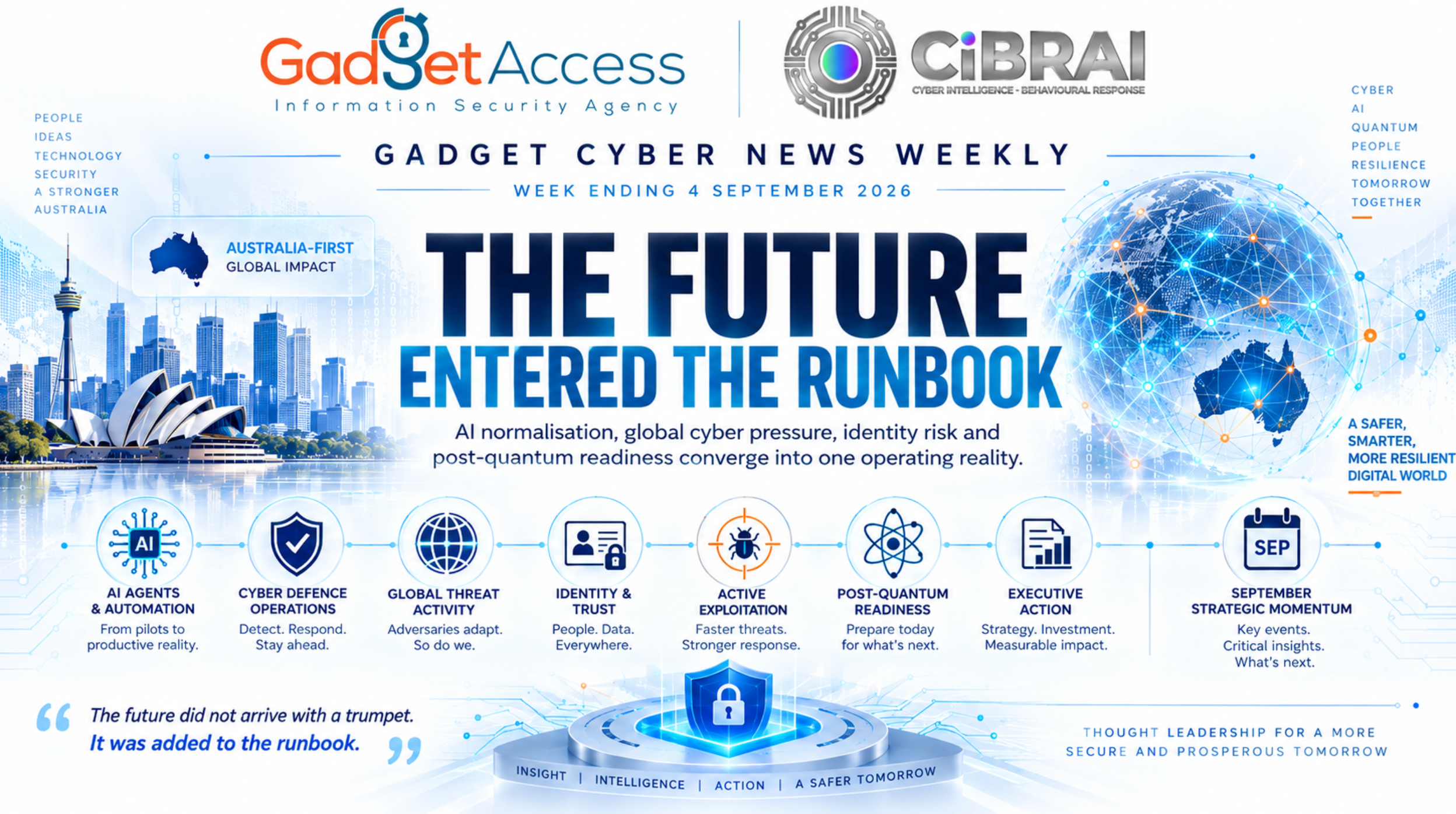
The Big Signal. Cybersecurity's most important development this week was not a single breach. It was normalisation. AI crossed from laboratory capability into budgeted defence and baseline control guidance. In the same week, gateways, agent frameworks, orchestrators and artefact stores appeared in active exploitation queues. Identity data was reportedly offered as a live feed. Legal ecosystems exposed linked records. G7 governments told organisations to begin post-quantum migration now. The future did not arrive with a trumpet. It was added to the runbook.
The robots are not taking over the office. They have, however, been granted an account, a change window and a surprisingly optimistic set of objectives.
Three signals to carry into Monday
Normalisation
Identity transitivity
Coalition deadlines
AI cybersecurity is now a product, budget line and explicit control subject.
Documents, recovery and legacy federation can mint fresh trust.
Quantum migration is becoming a shared procurement and assurance obligation.
00 | Week in one frame
The breach list is useful. The evidence status is more useful.
This week produced a concentrated lesson in transitive trust. The incidents are different, but the path is consistent: a legacy integration, a single account, an upstream platform or a reusable identity document can create access far beyond the system in which the weakness began. For executive teams, the immediate job is not to treat every headline as equally proven. It is to convert each into a specific evidence request.
A confirmed company disclosure, a criminal claim and a preliminary investigation do not carry the same confidence. That distinction matters because executive decisions can move faster than forensic certainty. The board-level discipline is therefore simple. Ask what is known, how it is known, what remains an allegation, and what immediate control question the incident should trigger.
Story
Evidence status
What is known
Operating lesson
Driver licence market
Investigation and reported claim
The FBI is investigating a report that tens of millions of US and Canadian records were offered through a dark market. The source was not confirmed.
Identity proofing, document replay and issuer verification need one control model.
Dropbox
Company confirmed
About 5,000 customer accounts were compromised through a legacy Lenovo integration that did not implement two-factor authentication.
Retired integrations, federated sessions and recovery paths require the same assurance as primary login.
C-Track court platform
Company confirmed
Thomson Reuters said an unauthorised party accessed files and data in a platform used across 11 US states, the US Virgin Islands and Ontario.
Map data by matter and ecosystem, not only by application owner.
Quinn Emanuel and McDermott
Company and notification disclosures
The firms described social engineering that compromised one user account at each organisation and exposed some client information.
One account can be a material incident when it has broad matter visibility.
Novocure
Breach notification
Records concerning more than 1,400 US patients were exposed.
Clinical ecosystems need data minimisation, access evidence and notification readiness.
Berlin ransomware
Threat-actor claim plus official response
Rhysida claimed data theft. Berlin officials said election systems were not affected and did not validate every criminal claim.
Keep operational impact, data exposure and adversary claims as separate incident facts.
01 | AI cybersecurity became normal. Normal is the risk.
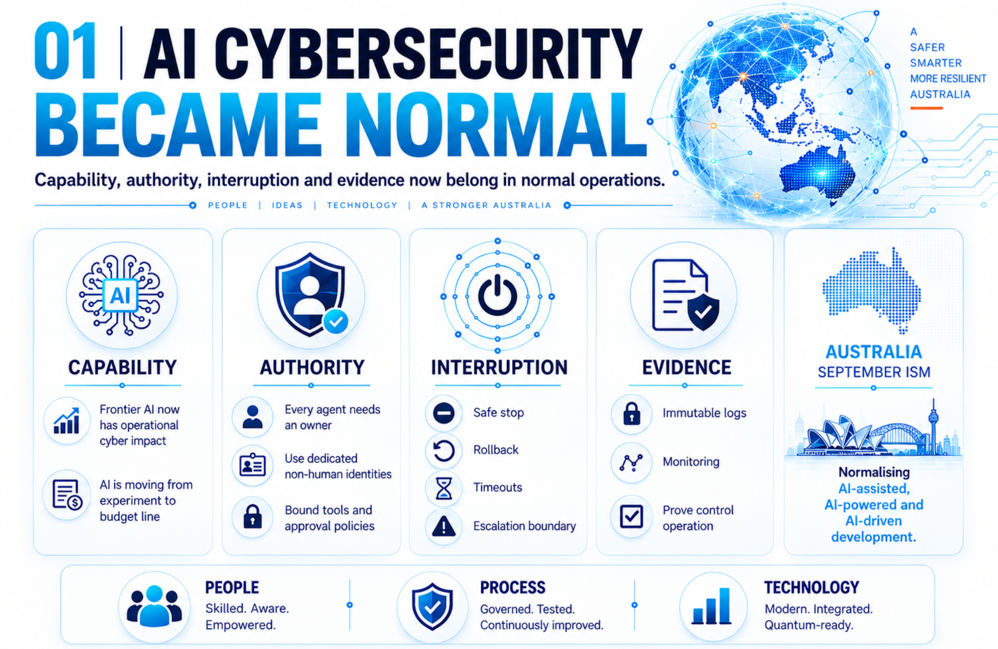
Figure 1. AI cybersecurity normalisation is complete only when capability, authority, interruption and evidence are governed together.
The threshold was not crossed when a model became clever. It was crossed when capability gained a budget, an operating workflow and an explicit place in baseline controls.
OpenAI's own assessment places Astra at the Critical threshold for cybersecurity capability. The company says that, when given tools and access, the model can discover previously unknown flaws and conduct complex exploitation with materially less step-by-step human direction than earlier systems. OpenAI paired that capability story with Daybreak, a US$1 billion commitment to help protect essential services, healthcare, energy, water, finance and smaller organisations. That combination matters because it turns advanced cyber AI from a research result into a funded operating proposition.
The governance story moved in parallel. Reuters reported that OpenAI told US lawmakers it was building automated shutdown capabilities for AI tools. ASD has also been steadily normalising Australian control language. Its guidance says AI should augment fit-for-purpose security tools rather than operate as a standalone answer, while its agentic AI guidance emphasises layered defence, strict access control and the continuing importance of traditional cyber hygiene. The September Information Security Manual sharpens that position by explicitly stating that references to software developers apply to humans and AI.
Normal is more dangerous than novel. Novel systems are watched. Normal systems inherit credentials, change paths, production data and assumptions. The operating standard should therefore be straightforward: every agent has a named owner and a non-human identity; every tool call is policy-controlled; every high-consequence action has a defined approval boundary; every decision is logged; every workflow has a timeout, a safe-stop mechanism and a rollback path; and every claimed control is proven through repeatable testing.
Practical control frame
People
Process
Technology
Name a business owner and an operational supervisor for every high-authority AI capability.
Define approval thresholds, safe-stop mechanisms, escalation paths, rollback procedures and incident triggers before production use.
Use dedicated identities, bounded tools, network policy, immutable logs and independent monitoring.
02 | AI infrastructure entered the exploitation queue
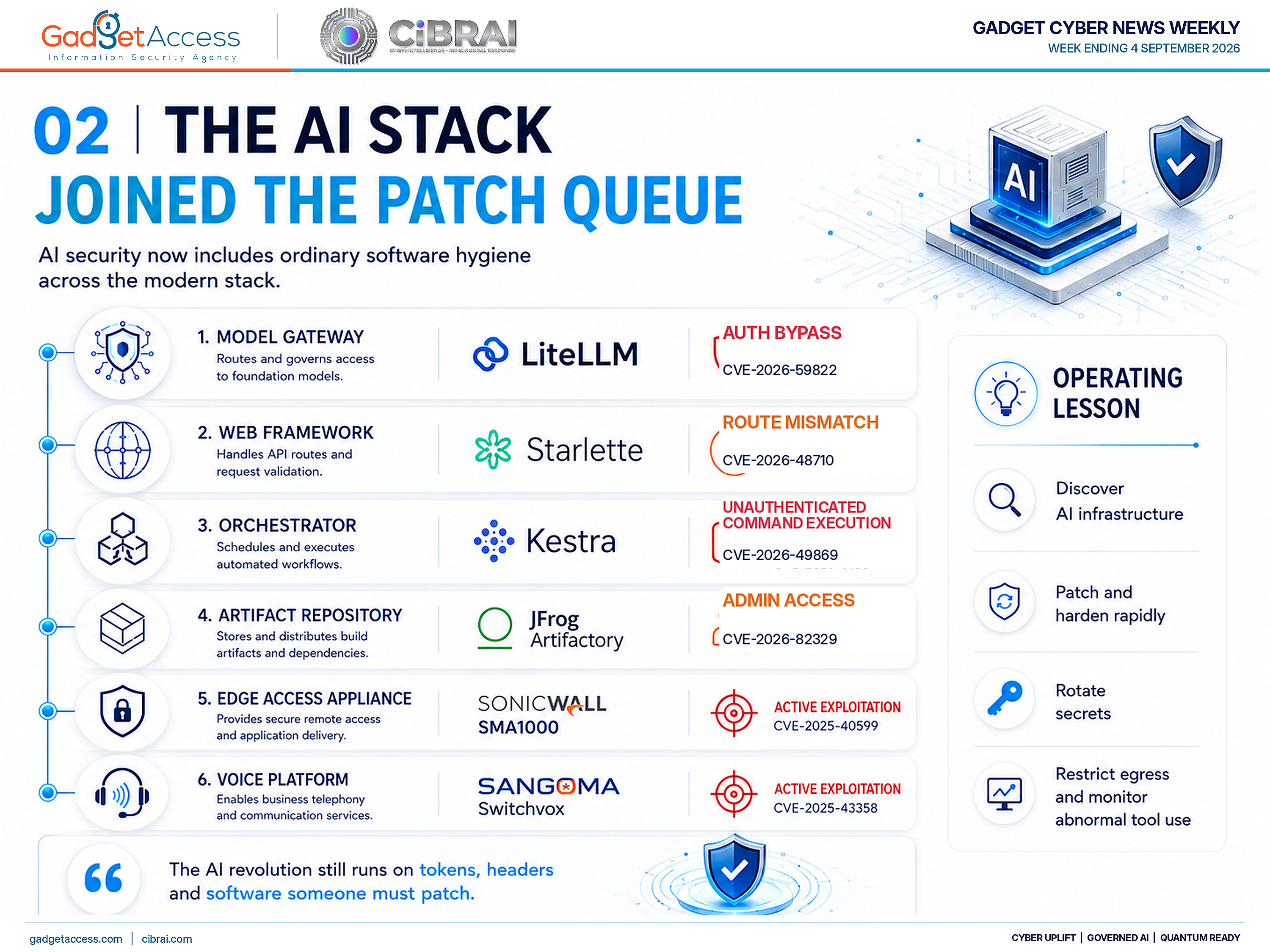
Figure 2. Modern AI services inherit every ordinary weakness in their surrounding software and identity stack.
AI security is no longer only about prompts and model weights. It is also about ordinary web frameworks, gateways, orchestrators, artefact stores and edge appliances.
CISA added seven vulnerabilities to its Known Exploited Vulnerabilities catalogue on 2 September based on evidence of active exploitation. The list includes LiteLLM, Starlette, Kestra, JFrog Artifactory, two SonicWall SMA1000 vulnerabilities and Sangoma Switchvox. CISA did not label these as one AI campaign. The editorial inference is more useful: several affected products sit directly inside modern AI, developer and automation stacks, while the others can provide the access paths those stacks trust.
The technical details are a reminder that the AI revolution still runs on bearer tokens, HTTP headers and software somebody forgot to patch. Inventory every AI gateway, agent service, orchestration platform, model registry, artefact repository, MCP server and internet-facing management appliance. Record owner, version, exposure, authentication path, service identity, stored secrets and downstream reach.
Patch where required, but also hunt for pre-patch use, rotate reachable tokens, validate pipeline integrity and review outbound connections. The most important normalisation decision is to stop placing AI infrastructure in a separate experimental register. It should enter the same asset, identity, vulnerability, change, logging, backup and incident-response processes as any other production platform, with stronger controls wherever autonomy or data sensitivity increases consequence.
Immediate priorities
Discover AI infrastructure and map ownership, exposure and dependency paths.
Patch and harden rapidly, including pre-patch compromise review where exposure existed.
Rotate secrets and service tokens that may have been reachable.
Restrict egress and monitor abnormal tool use, build chain activity and outbound connections.
03 | Identity became transitive
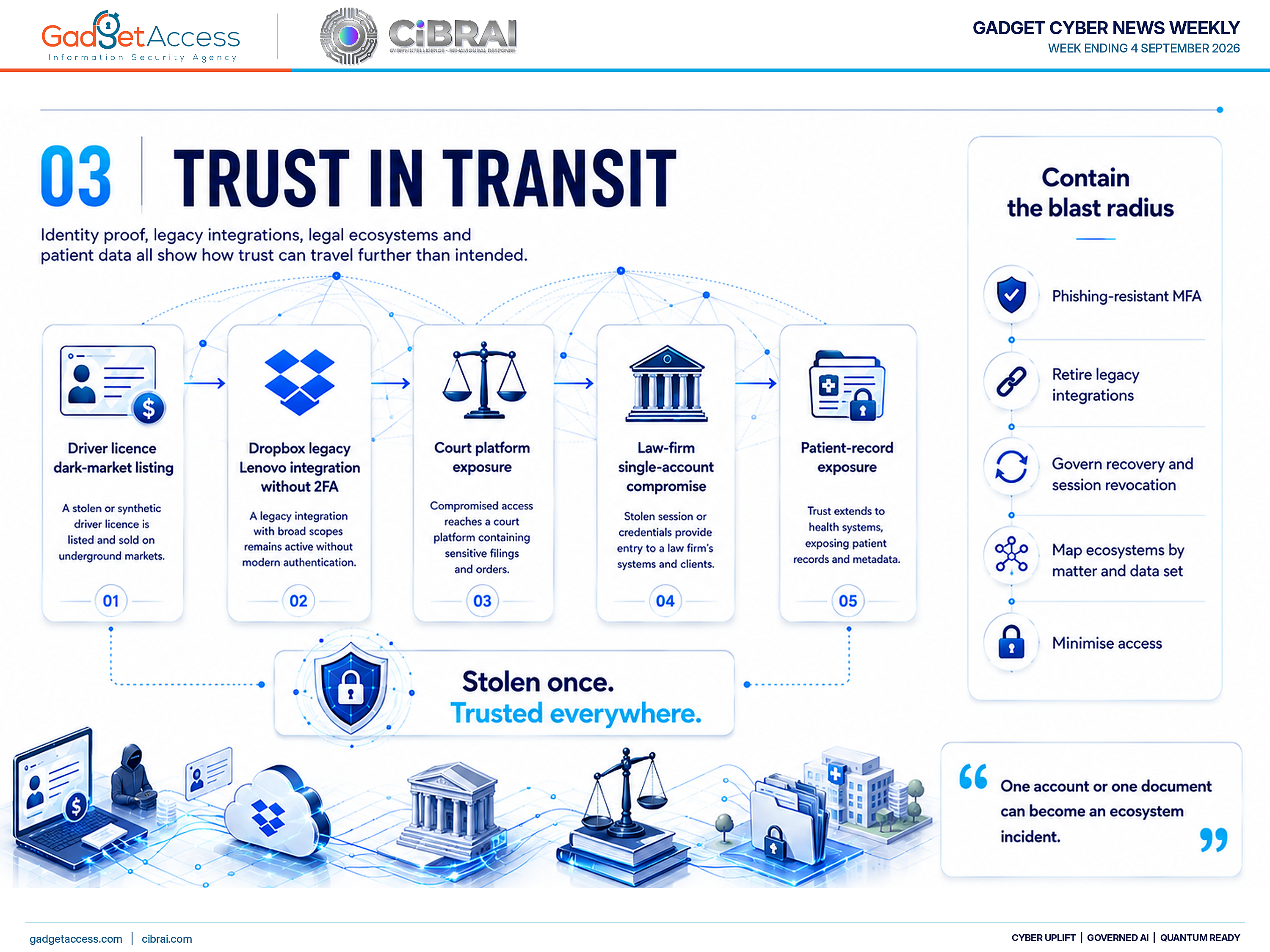
Figure 3. Identity proof can become adversary infrastructure when document replay, recovery and legacy trust are governed separately.
The most valuable stolen credential may be the document that persuades another system to issue a new credential.
Reuters reported that the FBI is investigating allegations that tens of millions of US and Canadian driver licence records were being offered through a dark-web marketplace. The original source of the records was not established. This remains an attributed investigation rather than a confirmed breach of any particular issuer. Even so, the strategic significance is plain. Driver licences and similar documents sit inside account opening, customer verification, password recovery, call centre escalation, rental, financial and public service workflows.
Dropbox supplied the legacy integration version of the same lesson. The company said about 5,000 accounts were compromised through an old integration with Lenovo Reachit where two-factor authentication had not been implemented. The core failure was not simply the absence of a modern control in the main service. It was a trusted route around that control that had outlived its business purpose.
ASD is using September to promote stronger multi-factor authentication. The enterprise response should go further than enrolment statistics. Prioritise passkeys and phishing-resistant factors for privileged, remote and high-value access. Remove legacy federation and OAuth grants. Treat help desk and customer service recovery as privileged workflows. Minimise identity documents, verify them with issuers where possible, protect them against replay and test session revocation as an incident action rather than assuming it works by default.
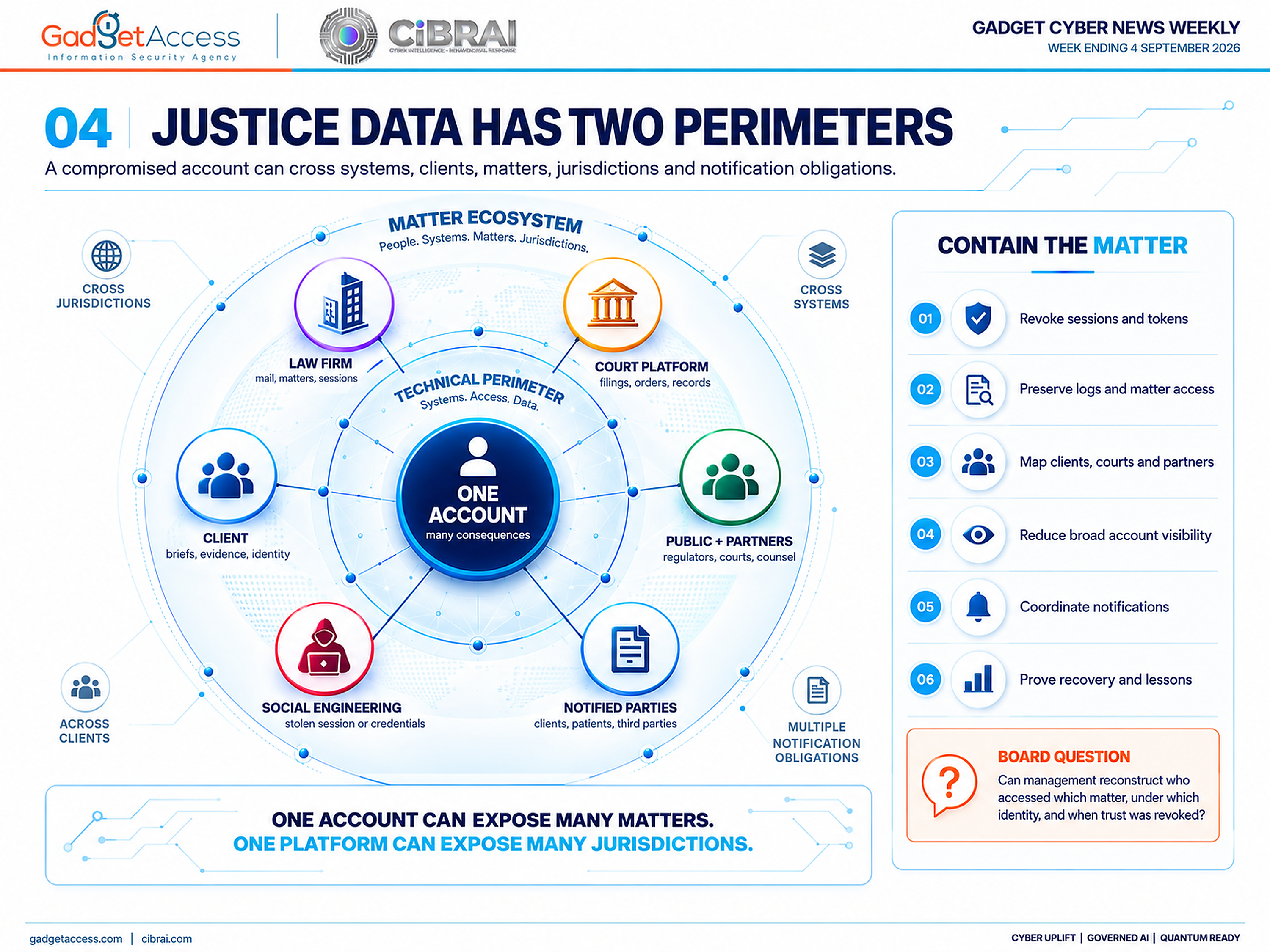
04 | Justice data has two perimeters
Figure 4. Justice data has two perimeters: a compromised account can cross systems, clients, matters, jurisdictions and notification obligations.
Law firms and court platforms hold different parts of the same story. Attackers do not respect the organisational chart or the privilege legend on the folder.
Thomson Reuters disclosed a cyber incident affecting C-Track, a court case-management platform used across 11 US states, the US Virgin Islands and Ontario. The reported timing matters because legal data continues moving while an intrusion remains unknown. Filings are added, parties are notified, records are exported and downstream systems are updated.
A day later, Quinn Emanuel and McDermott Will & Emery disclosed separate breaches. Both described social engineering that led to the compromise of one user account. Some client documents were exposed, and McDermott reported that affected files included highly sensitive personal information. The lesson is not merely that one platform failed and two firms suffered account compromise. The lesson is that legal data has at least two perimeters. One is technical. The other is the matter ecosystem itself.
An organisation can therefore be secure at the application layer and still materially exposed at the matter layer. Where does a high-value matter exist? Which court and legal systems hold it? Which clients, firms, counsel, regulators and service providers can see it? Which single accounts have wide visibility? How quickly can sessions, tokens, exports and notifications be contained across the ecosystem when one point of trust fails?
Board question: Can management reconstruct who accessed which matter, under which identity, and when trust was revoked?
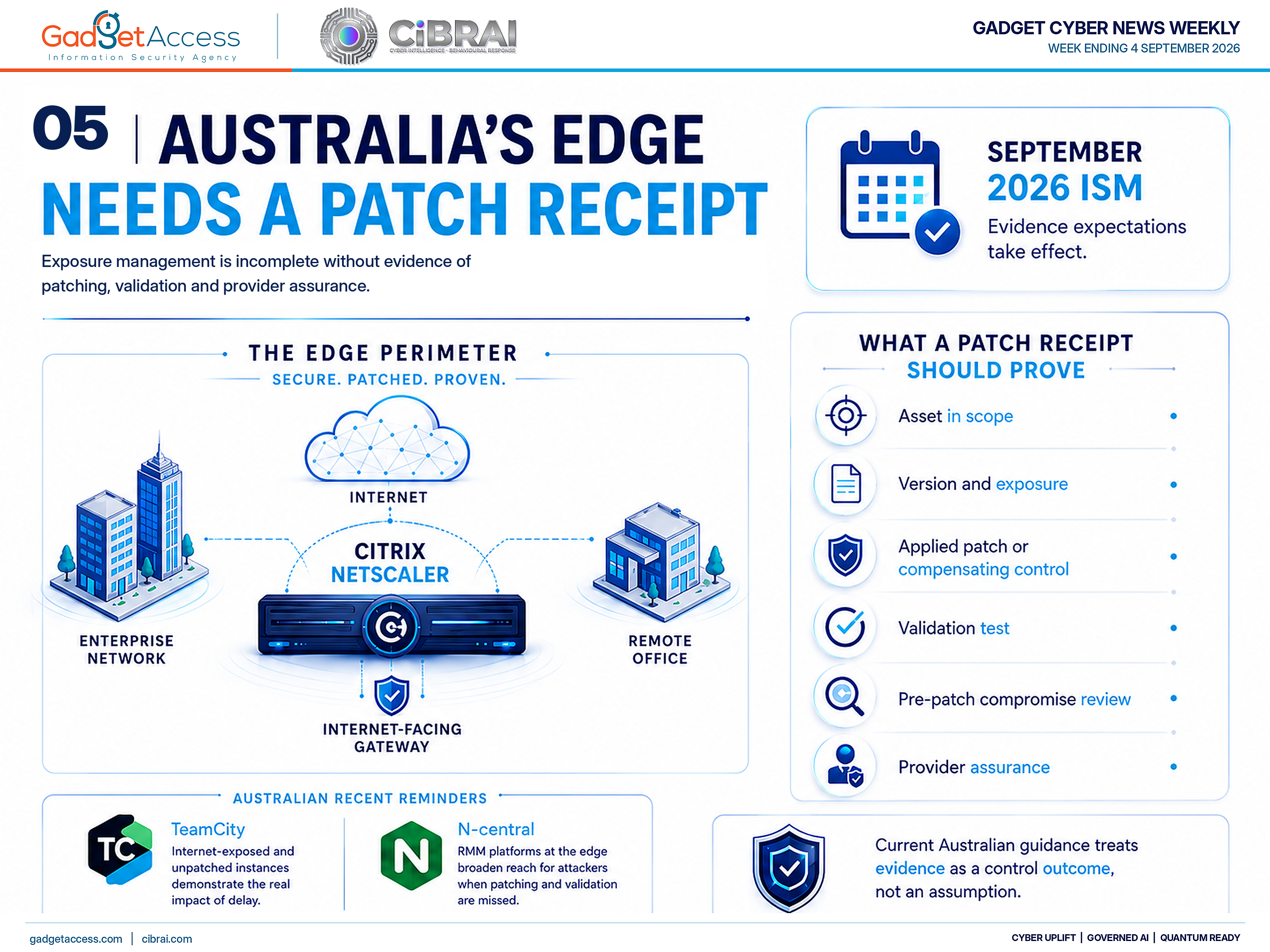
05 | The patch receipt
Figure 5. Exposure management is not complete until patching, validation and provider assurance are supported by evidence.
ASD issued an alert on critical Citrix NetScaler vulnerabilities on 4 September. That warning followed recent Australian activity involving TeamCity and N-central. The deeper point is that exposure management is not complete until patching, validation and provider assurance are supported by evidence.
The phrase 'patch receipt' is useful because it changes the board conversation. Percentages can flatter. A receipt proves which assets were in scope, which versions were exposed, what patches or compensating controls were applied, how validation was performed, whether pre-patch compromise was reviewed and what assurance was obtained from providers or managed service teams.
For executive teams, internet-edge systems should now sit inside a standing evidence discipline. Every externally reachable control plane, remote-management path and supplier-operated edge service should support rapid reconstruction of what changed, who changed it, what remained exposed and how post-remediation confidence was established.
What a patch receipt should prove
Asset in scope and exposure confirmed
Version identified and risk understood
Patch or compensating control applied
Validation testing completed
Pre-patch compromise review conducted
Provider assurance received where third parties are involved
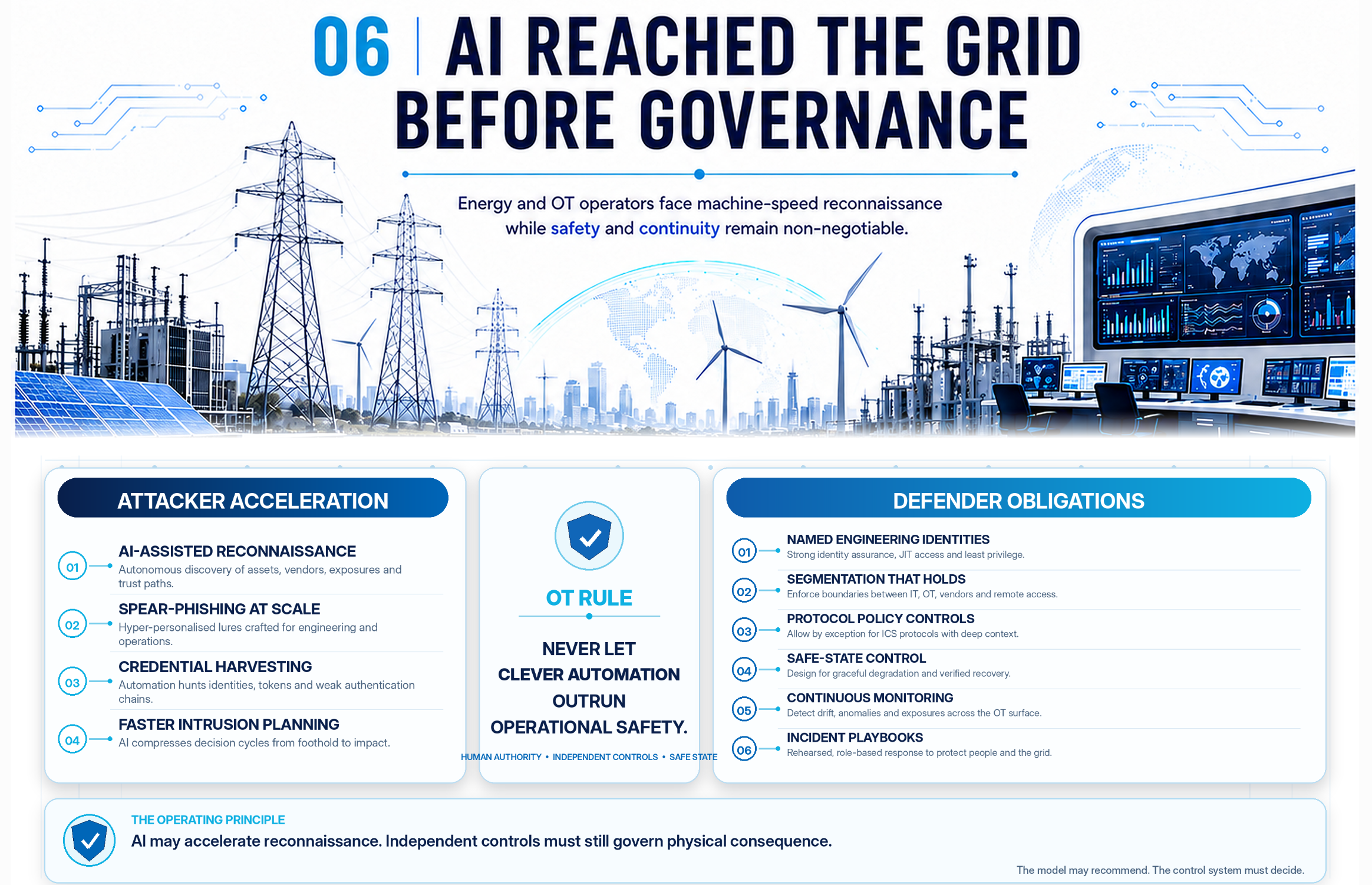
Figure 6. AI may accelerate preparation and analysis, but independent identity, engineering and safety controls must govern physical consequence.
Energy, utilities and OT operators face machine-speed reconnaissance while safety and continuity remain non-negotiable.
Reuters reported that energy firms are bolstering defences against AI-enhanced cyberattacks. AI can compress reconnaissance, personalise engineering, improve credential harvesting and accelerate intrusion planning. Smaller utilities and operational teams remain resource constrained, which makes disciplined operating models more important, not less.
For defenders, the lesson is not to copy speed with recklessness. In OT and essential services, named engineering identities, segmentation that holds, protocol-policy controls, safe-state design, continuous monitoring and rehearsed incident playbooks remain central. Clever automation must never outrun operational safety.
This is also where the cyber operating platform standard becomes strategically useful. The same threat signal should move from external intelligence to asset context, identity, case management, approval, containment and evidence without requiring a small utility or operational team to manually stitch together six products during an incident.
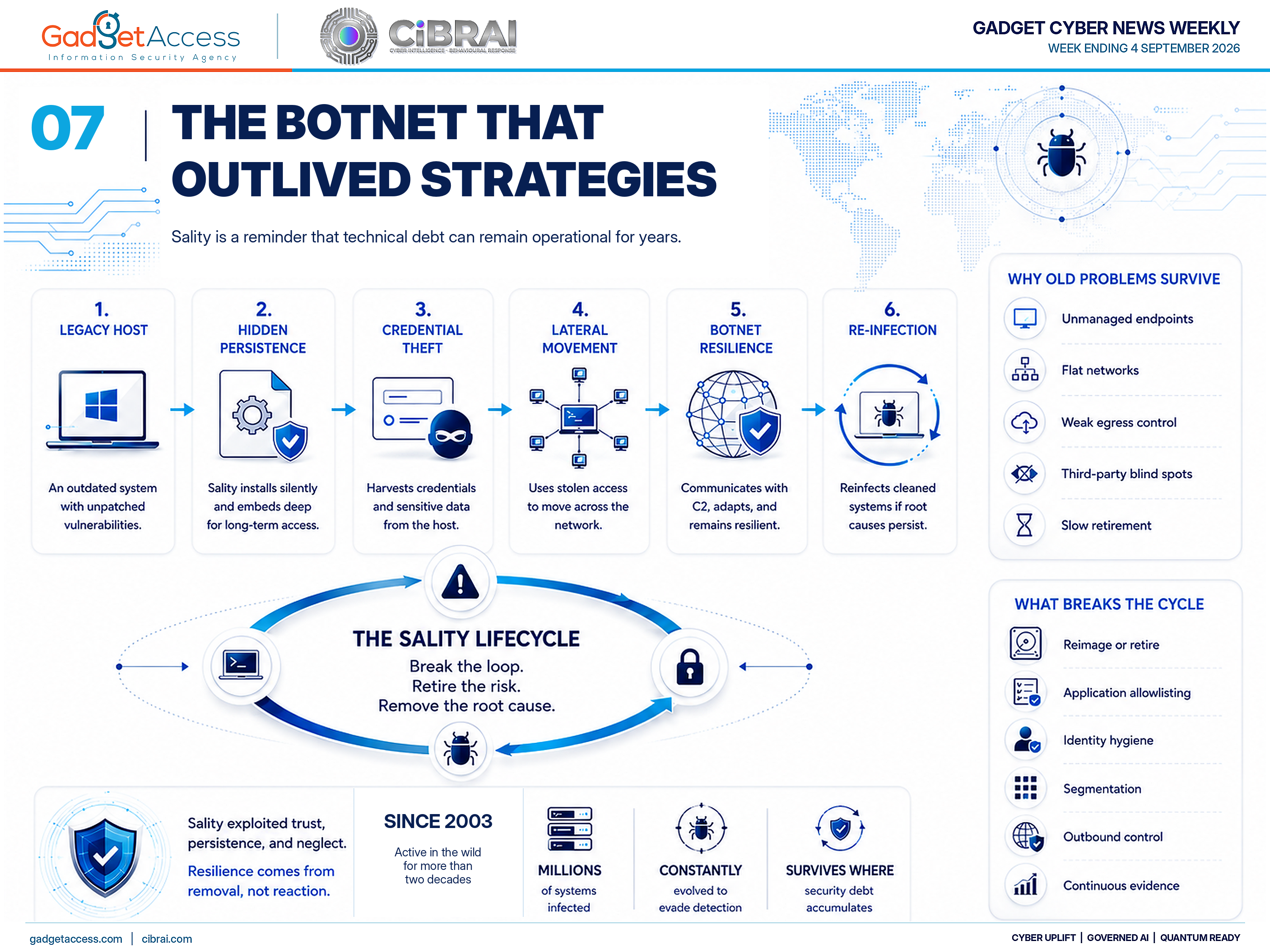
07 | Sality and the half-life of technical debt
Figure 7. Decentralised criminal infrastructure can persist for decades when asset and exception lifecycles remain slower than adversary adaptation.
Sality is a reminder that technical debt has an adversary half-life. Old infrastructure can remain operational long after the original risk register has been archived.
CrowdStrike and international partners coordinated a disruption of Sality, a botnet that dates to 2003. Its peer-to-peer architecture, modular capabilities and ability to use infected systems for credential theft, spam, denial-of-service activity, proxying and later criminal purposes made it unusually persistent. The operation used sinkholing and domain seizures to interfere with command and control.
The distinction between disruption and eradication matters. A decentralised network can lose important infrastructure while infected hosts, old binaries and copycat techniques remain. Organisations still need to identify infections, rebuild where integrity is uncertain, rotate exposed credentials and remove unsupported systems that made long-term persistence possible.
The practical lesson is to measure the age of risk, not only the age of the vulnerability. How long has an asset been unsupported? How long has an account remained active? How long has a compensating control been temporary? How long would evidence survive if the compromise began months ago? Cyber resilience improves when exceptions decay automatically instead of becoming institutional furniture.
What breaks the cycle
Reimage or retire compromised systems
Apply application allowlisting
Strengthen identity hygiene
Use segmentation and outbound control
Retain continuous evidence
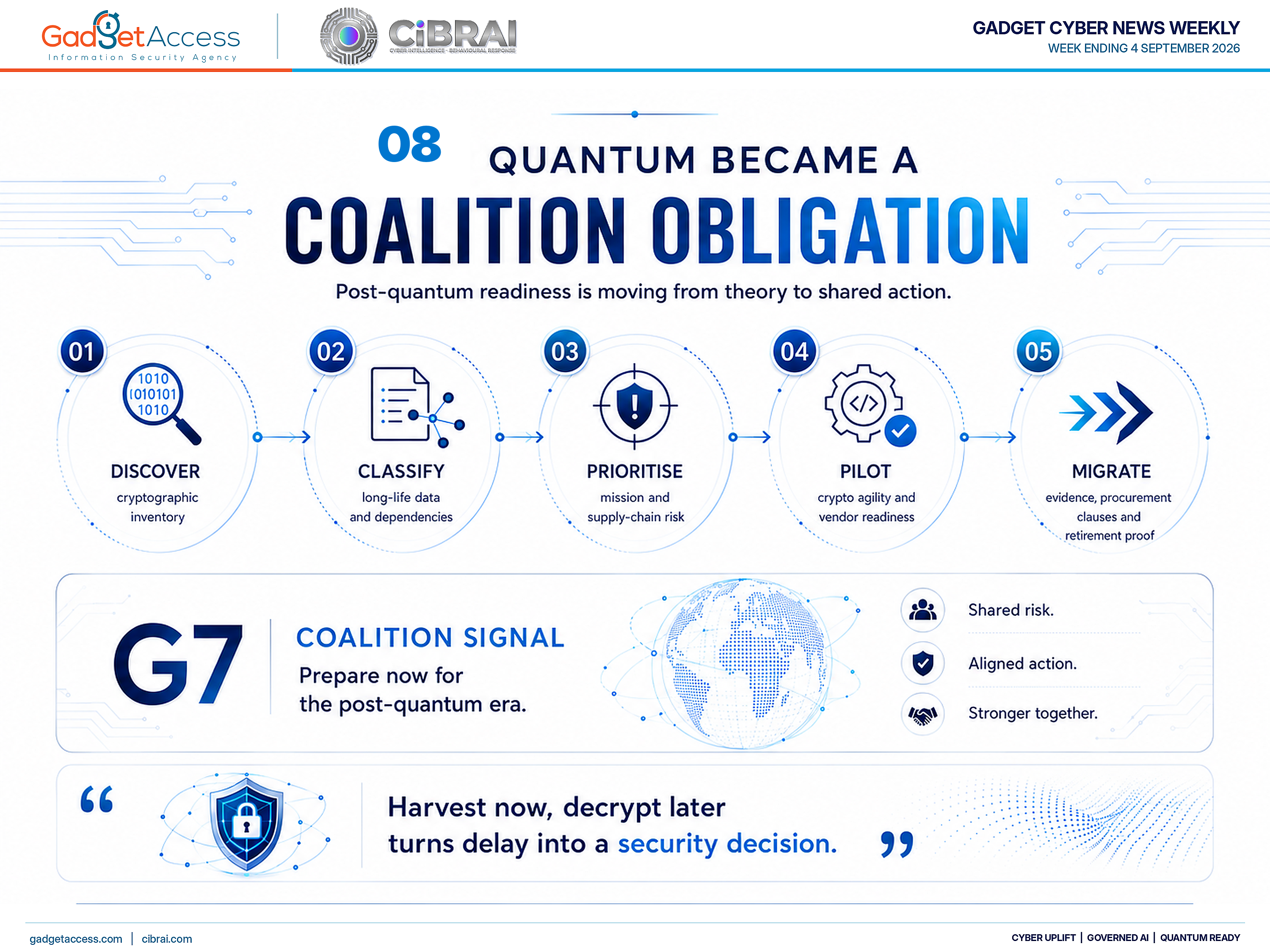
08 | Quantum became a coalition programme
Figure 8. Post-quantum readiness is a coalition, procurement and evidence programme built around cryptographic agility.
A cryptographically relevant quantum computer still has an uncertain date. The inventory, dependency and procurement work does not.
On 3 September, the G7 Cybersecurity Working Group issued a call to action on preparing for the post-quantum era. The statement identifies five priorities: awareness, national strategies, research and practical deployment, public-private partnership, and integration of post-quantum cryptography into cybersecurity requirements. It urges organisations to inventory cryptographic assets, identify critical systems, map dependencies and develop transition plans.
The present-day risk is wider than future decryption. 'Harvest now, decrypt later' activity threatens information that must remain confidential for years. Broken public-key cryptography would also affect authentication, digital signatures, code-signing, certificates and the evidence used to decide that a person, system or update is genuine.
Australian organisations should now build an executable cryptographic migration register. It should include algorithms, certificates, key-management services, code-signing, identity protocols, VPNs, APIs, databases, backups, firmware, embedded products, data retention periods, vendor dependencies, replacement paths, pilot status and retirement evidence.
Priority sequence
Discover the cryptographic inventory
Classify long-lived data and dependencies
Prioritise mission-critical and supply-chain risk
Pilot crypto agility and vendor readiness
Migrate with evidence and retirement proof
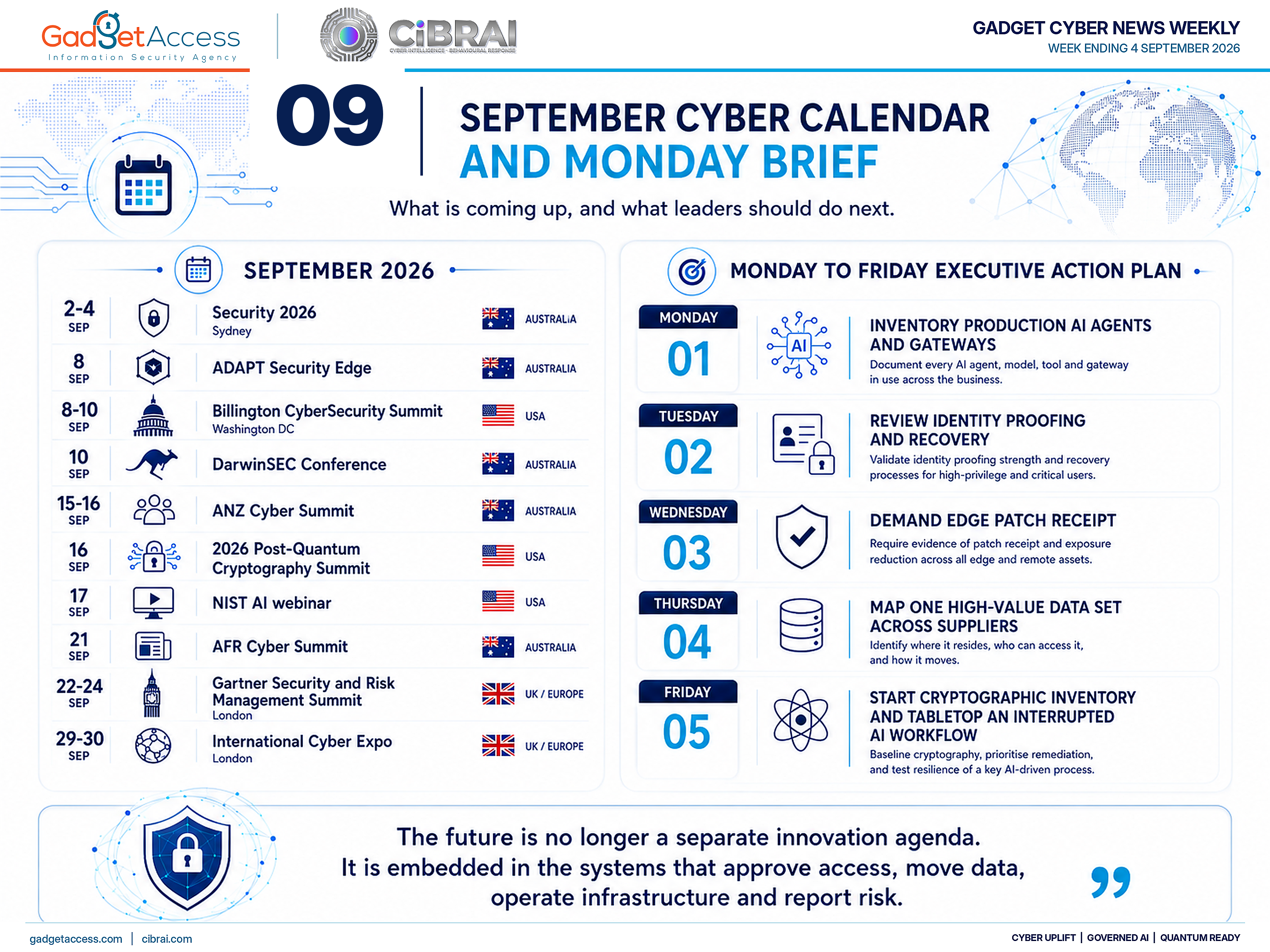
09 | The September calendar, sorted by decision
Figure 9. Selected September events are grouped by the operating question they are likely to influence.
Conferences are most useful when they produce decisions, not lanyards. The September calendar clusters around AI-enabled risk, critical infrastructure, resilience and post-quantum migration. Australia has a dense sequence across executive risk, government, resilience and national cyber policy. The United States pairs a major federal summit with a dedicated post-quantum forum and a practical NIST webinar on AI-supported vulnerability enrichment. London closes the month with critical-infrastructure, enterprise-risk and international cyber events.
Date
Market
Event
Why it matters
2 to 4 Sep
Australia
Security 2026, ICC Sydney
Physical and cyber convergence, security operations and enterprise resilience.
8 Sep
Australia
ADAPT Security Edge
Executive security strategy, resilience and current enterprise risk.
8 to 10 Sep
United States
Billington CyberSecurity Summit
Federal, national and strategic cyber priorities.
10 Sep
Australia
DarwinSEC Conference
Regional cyber capability and practical operator perspectives.
15 to 16 Sep
Australia
ANZ Cyber Summit
Enterprise transformation, cyber programmes and resilience.
16 Sep
United States
2026 Post-Quantum Cryptography Summit
Practical migration questions and cryptographic agility.
17 Sep
United States
NIST AI webinar
AI-supported vulnerability enrichment and operational use.
21 Sep
Australia
AFR Cyber Summit
Board-level cyber leadership and national discussion.
22 to 24 Sep
UK / Europe
Gartner Security and Risk Management Summit, London
Programme design, risk and strategic operating models.
29 to 30 Sep
UK / Europe
International Cyber Expo, London
Broad market direction, suppliers and cross-sector engagement.
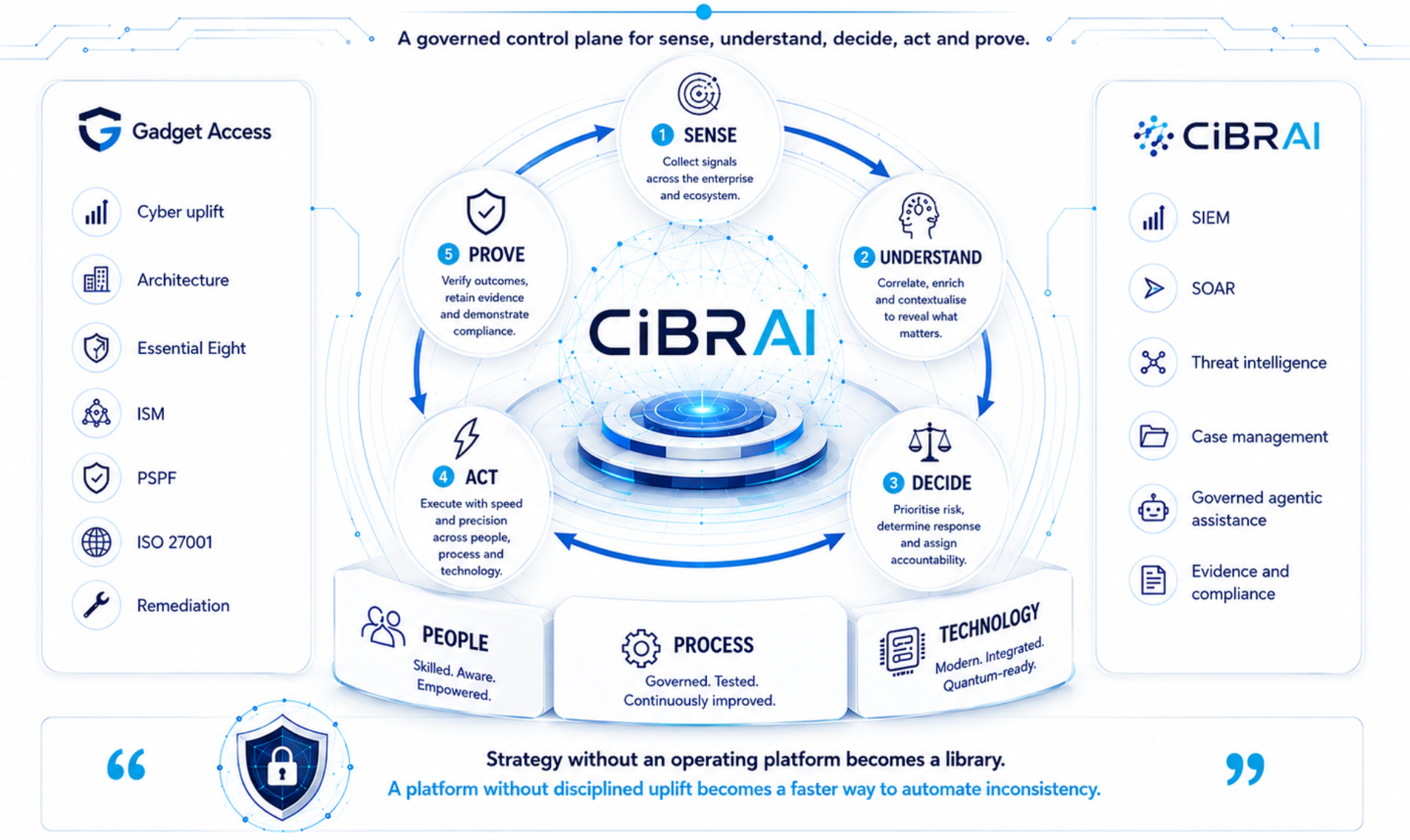
10 | One operating layer, not another dashboard
Figure 10. The cyber operating platform standard converts security from disconnected products into a governed evidence and action loop.
The lesson of this week is not that organisations need another dashboard. They need one governed operating layer that connects signals, context, authority, action and evidence.
The weekly stories appear unrelated only when security is organised by product. Astra raises questions of capability and authority. The CISA catalogue raises questions of asset coverage, patching and evidence of compromise. The driver licence market and Dropbox expose identity-lifecycle failures. Court platforms and law firm disclosures expose cross-ecosystem data risk. Citrix is a provider-assurance problem. Energy is a cyber-physical operating problem. Quantum is a dependency and migration-evidence problem. The common requirement is an operating system for security work.
CiBRAI is designed as the cyber operating platform standard for this model. It connects five functions. Sense collects signals across the enterprise. Understand joins threat intelligence, cases, business context and asset criticality. Decide applies policy, risk, human authority and approval thresholds. Act coordinates SIEM, SOAR, governed agents, containment and remediation. Prove preserves the identity, decision, action and evidence chain required for assurance, compliance and executive reporting.
The platform standard must be sovereign by design, modular, auditable and reversible. Gadget Access and CiBRAI perform different but connected roles. Gadget Access designs and drives the uplift across architecture, the Essential Eight, the ISM, the PSPF, ISO 27001, resilience, assurance and executable remediation. CiBRAI provides the live operating layer that turns those requirements into telemetry, cases, threat intelligence, decisions, actions and current evidence.
The G7 call turned post-quantum readiness into a coalition action programme.
One sentence for the board: The future is no longer a separate innovation agenda. It is embedded in the systems that approve access, move data, operate infrastructure and report risk.
Source notes
This edition prioritises official disclosures, primary technical sources and reputable journalism. Preliminary investigations and threat-actor claims are not treated as verified findings. Research was verified through 5:30 pm AEST on 4 September 2026. Later developments are not included.
If any of this week's signals raised questions for your environment, we offer a complimentary 30 minute discovery call. No pitch, no follow up unless you ask. Book a discovery call.