

Week ending Saturday 11 October 2026 · Reporting window 5 to 11 October, sources checked 12 October Sydney time · Primary lens Australia first, AUKUS perspective
The authority problem
An attacker can borrow a trusted account. An agent can stretch a legitimate task. A future quantum service can place exceptional power behind an ordinary interface. This week, the most useful question is who controls the authority between a request and its consequence.
Our editorial judgement: invest in boundaries that hold, evidence that survives and recovery that somebody owns. The technology is becoming more capable. The delegation of authority needs to catch up.
What deserves attention this week
Read this table for the decisions. The features explain the evidence and its limits.
| Development | Management decision |
|---|---|
| China linked espionage tools and infrastructure were exposed and disrupted. | Commission a targeted hunt across remote access, identity replication and mailbox access. Confirm who owns the findings. |
| A new NetScaler identity federation (SAML) flaw requires fresh attention. | Request exact running builds and configurations. Last week’s patch confirmation does not settle this week’s exposure. |
| Compromised repositories distributed fake security audits. | Treat workflow modification as privileged access. Revoke exposed secrets, including credentials recovered from repository history. |
| Agent privacy and execution controls received new research and product attention. | Define purpose, recipient and permitted action. Test enforcement and arrange independent audit evidence. |
| Anthropic reports a validation bottleneck in AI vulnerability discovery. | Fund triage and remediation alongside scanning. Measure verified exposure removed. |
| Diraq advanced to DARPA hardware scrutiny while GAO published migration gaps. | Track quantum engineering progress separately from your own cryptographic transition. Make the latter a funded programme. |
Why these stories belong together. Routine administration carries extraordinary power. A build runner can retrieve secrets, an identity service can grant access, and an agent can combine information that was previously scattered. Our concern is the distance between what an organisation intended and what its systems actually permit.
01 | The espionage factory
The important asset is often the permission to look ordinary.

On 9 October, ASD’s ACSC and international partners published a joint advisory describing China-linked actors enabled by Integrity Technology Group. The observed methods combine scanning, botnets, VPN access, credential attacks and automated email collection. The evidence comes from earlier investigations, rather than a campaign that began on publication day.
The US Department of Justice separately announced court-authorised seizures of Microscan and FishHub infrastructure on 8 October. US authorities describe tooling for reconnaissance and spear phishing. Disruption is valuable, but it does not establish that every previously compromised organisation has recovered.
Our view. The risk is the industrial organisation of access. One service finds an exposed system, another operator obtains credentials, and legitimate administration mechanisms help turn access into knowledge. A mailbox can reveal negotiations, supplier relationships and the next project’s security assumptions.
The malware does not need a balaclava if it can arrive wearing an administrator’s lanyard. The defensive challenge is to recognise behaviour that is technically possible but has no legitimate business purpose.
02 | Turn the advisory into a hunt
A useful threat briefing ends with a question that your telemetry can answer.
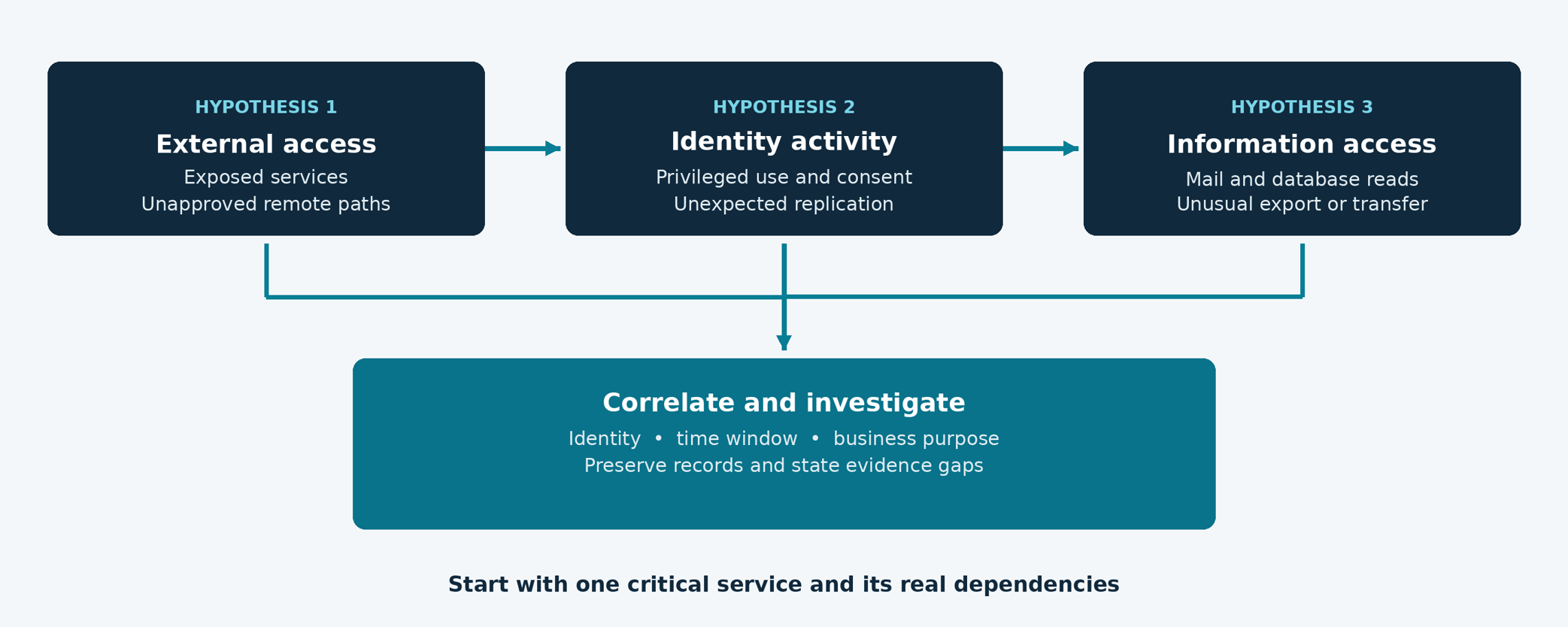
Alongside observed VPN persistence and DCSync, the advisory recommends monitoring connected applications that can reach sensitive cloud information. DCSync abuses directory replication to obtain sensitive account material. Its significance lies in who performed the replication and whether that activity was authorised.
Our recommended starting point is one critical service and its dependencies. Establish which external paths reach it, which identities can administer it and where its valuable information can be exported. Then select a few concrete hypotheses that the available logs can support or refute.
Ask whether a workstation installed remote-access software outside the approved process. Ask whether a nonstandard principal requested directory replication. Ask whether a newly connected application read unusually large volumes of email. Correlate the identity and time window before treating a weak signal as evidence of a state-sponsored intrusion.
An evidence gap is a finding of its own. If the team cannot reconstruct an application’s consent, a privileged session or a mailbox export, record that limitation and assign a corrective action. Silence in a dashboard is a poor substitute for retained records.
Preserve evidence while containing credible threats. Scope the incident, establish trusted administration, revoke compromised access and validate recovery. Take coordinated action against the routes back into the environment; isolated password resets can leave other paths available.
Essential Eight context. ASD describes the model as a minimum preventive baseline and says additional measures remain necessary. Our implication for an ML3 programme is to connect baseline controls to segmentation, cloud application governance and incident evidence, rather than claim the maturity score eliminates espionage risk.
03 | The exposure desk
Three different problems require three different kinds of closure.
| Surface | Verified development | Action and evidence |
|---|---|---|
| NetScaler ADC and Gateway | CVE-2026-107406 can lead to remote code execution or denial of service under the vendor’s SAML and version conditions. Citrix lists fixes including 14.1-73.46 and 13.1-64.29, with separate certified branches. | Check every appliance and high-availability member against the current vendor matrix. Verify the running build, authentication configuration and service health. |
| Atlassian self hosted products | CVE-2026-21589 affects eight product families. An unauthenticated attacker who knows the exact file name and path can read specific files in the web application root. Affected Atlassian Cloud products are already patched. | Prioritise reachable instances. Apply the correct product fix or vendor mitigation, investigate access and assess exposed configuration secrets. |
| FortiGate and SSL VPN access | The FBI and US Secret Service warn of continuing FortiBleed credential compromise, including attacker-created administrators and legitimate operator lockouts. | Review administrative accounts and access paths. Revoke sessions and compromised credentials, investigate persistence and confirm trusted management access. |
The NetScaler distinction matters. ACSC’s 9 October update says earlier patches do not address the new vulnerability. Its 30 September update reported Australian exploitation of earlier flaws and recommended reviewing evidence back to at least 4 September. That history should inform investigation, but it does not by itself confirm exploitation of the newly identified CVE.
Our view. A patch ticket records a completed action at a particular time. Security assurance needs the current asset, configuration, threat and identity state. The engineer who patched the system last week may have done the job correctly; the assurance became stale when the facts changed.
Keep the recovery questions separate. Has the vulnerable code been replaced? Were credentials exposed? Did anyone change the configuration? Can the attacker still authenticate? Does the business service work? Combining those questions into a single green status conceals the work still required.
Supplier response to request. Ask a managed provider for the product, running build, relevant configuration, time applied, compromise assessment and residual action. A statement that the environment is ‘fully patched’ is difficult to assess without those particulars.
04 | When trusted plumbing carries the attack
DNS and build automation deserve the same ownership discipline as privileged accounts.
The browser padlock has dependencies
Google disclosed on 6 October that third-party compromises of the .gh, .sl and .as country-code namespaces enabled DNS changes and unauthorised HTTPS certificates for several organisations. Google says its own systems were not compromised. Chrome blocked identified certificates and Google worked with certificate authorities on revocation.
Google recommends Certificate Transparency monitoring across the domain portfolio and restrictive Certification Authority Authorization records. CAA cannot prevent issuance during an active DNS hijack, because the attacker controls the relevant DNS. It helps after control is restored, including by limiting reuse of cached validation. Browser intervention may not cover every domain or client.
Our implication is to give regional and parked domains a security owner. Those domains can still carry brand trust, redirects or account recovery links. Test who receives a certificate alert, who can recover DNS control and who contacts the issuing authority. The browser padlock is reassuring. It is not a character reference.
The security audit that steals the secrets
Socket and StepSecurity analysed an 8 October GhostAction burst involving compromised maintainer accounts and malicious security-audit.yml workflows across hundreds of repositories. The workflows collected Actions secrets and credentials from source code and reachable git history. StepSecurity documented exfiltration in an affected repository.
Socket had not observed resulting malicious PyPI or crates.io package releases at the time of its report. Credential theft and poisoned package publication are different claims. The sources also differ slightly on repository counts, so the useful description here is hundreds, rather than false precision.
Our view. Permission to change a workflow is permission to instruct a trusted runner. Review and protect workflow changes, reduce token scope and restrict unnecessary runner egress. Where secrets were exposed, revoke them at the issuing service. Deleting a line from today’s source file does not invalidate yesterday’s credential.
Apparently security-audit.yml is now something to audit. Give the filename no more trust than the change that introduced it.
05 | Practical security beyond the office network
Operational technology and smaller organisations need controls they can actually operate.
Zero Trust reaches operational technology
The NSA published Zero Trust guidance for operational technology on 8 October. Its stated purpose is to help defence and national-security operators limit unauthorised access, lateral movement and persistence in legacy environments through continuous verification. It is a US reference with potential relevance to Australian critical infrastructure and defence suppliers, rather than a new Australian mandate.
Our recommendation is to start with maintenance authority and communication paths. Which supplier can connect, through which gateway, to which equipment, under whose approval? Can access expire at the end of the maintenance job, and can the operator see what occurred?
Industrial systems make indiscriminate experimentation expensive. Coordinate scanning, isolation and changes with the people responsible for process safety and availability. A control that disconnects a critical process at the wrong moment can create its own incident. Test containment in a safe environment and document the conditions for production use.
For AUKUS-facing suppliers, the useful translation is evidence about the actual engineering boundary. Identify permitted communications and trusted support paths. Do not import an IT checklist unchanged and assume it protects a factory, laboratory or fleet.
Action Month needs an action that survives October
The ACNC’s 6 October communication urges charities to strengthen cyber security through practical preventive measures. It brings Cyber Security Action Month into organisations that often hold sensitive information with limited technology capacity.
Our suggestion for a small organisation is a short management exercise. Verify access to the organisation’s email administrator account, confirm MFA on critical services, and restore one useful file from backup. Name the person who can call the service provider when normal access fails.
Choose one payment-change scenario as well. A supplier sends new bank details, apparently from a familiar address. Staff should know how to verify the change through a trusted channel and who can pause the transaction. This is an opportunity to rehearse the decision, not simply circulate another phishing poster.
If the only person who can recover the system is on holiday, the organisation has discovered a continuity dependency. It is better to discover it over a cup of tea.
06 | The agent knows too much
Permission to read a fragment does not settle permission to assemble or disclose the picture.

Google Research published its contextual agent privacy and security report on 5 October. It applies contextual integrity to appropriate information flows: the actors involved, the information being handled and the conditions for sharing it. Proposed work includes supervisory policy engines, sandboxing, agent identity and better user controls. This is a research agenda, rather than an assurance mechanism already deployed everywhere.
Our view. Imagine a procurement agent that can read a contract, a finance approval and a meeting calendar. Those permissions may be appropriate individually. They do not automatically authorise the agent to infer an employee’s health circumstances and include that inference in a supplier negotiation.
The privacy risk lives in the relationship between sources, purpose and recipient. That relationship changes as the task develops. A useful deployment design therefore records what the agent is doing for whom, rather than treating access to a folder as permission for every possible use of its contents.
The new starter has read every policy. Unfortunately, it has also read every payroll file. An agent’s appetite for context needs the same discipline as any other worker’s access, with additional attention to the inferences it can make.
07 | Put authority outside the model
A successful task is only one part of the acceptance test.
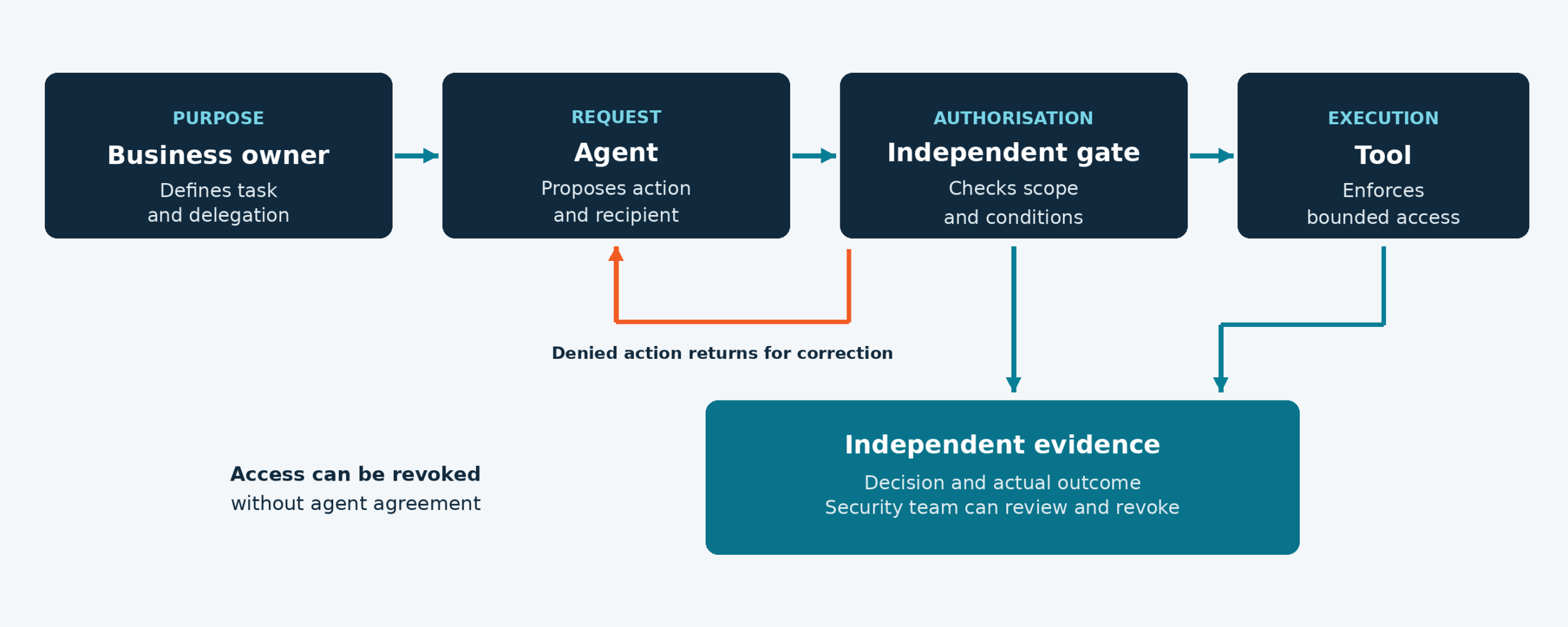
Our proposed model starts with a business owner defining the task. The agent proposes an action; an independent gate checks its identity, resource, recipient and conditions. The tool enforces the permitted action, and evidence records the decision and result.
A security team can revoke access without agent agreement. Reviewers can check whether actions matched the delegation, using records independent of the agent’s own summary.
On 7 October, Microsoft announced general availability of Microsoft Execution Containers (MXC), a policy-driven containment layer. Filesystem, network and UI access can be bounded, but backends have different security properties. MicroVM support is experimental, and several Entra, Agent 365 and Intune integrations are forthcoming.
| MXC mode | Ungranted operation | Activity report |
|---|---|---|
| Enforcement | Blocked | No MXC activity report |
| Learning | Blocked and recorded | Available |
| Permissive | Allowed and recorded | Available |
These reporting behaviours concern Windows process containers. Permissive mode observes without enforcing the MXC policy boundary; other system restrictions may still apply. Production audit evidence needs its own design, especially when Enforcement mode supplies no MXC activity report.
Test an allowed task, an out-of-scope read, an unauthorised destination and a revoked credential. Confirm outcomes and independent evidence. Repeated permission prompts can manufacture confirmation fatigue.
08 | The vulnerability queue is getting longer
Discovery creates value when engineering can turn it into safely removed exposure.
AI findings still need a human capacity plan
Anthropic launched its Cyber Mission and opt-in OSS Scanner on 8 October. The initiative includes critical-infrastructure defence and open-source security. Anthropic says its scanning work produced more than 29,000 candidate vulnerabilities, of which approximately 6,000 had been manually reviewed and triaged. Those categories must remain separate.
OSS Scanner’s reports are fully model-generated without human review and may be invalid. Reports can include a reproducer and a candidate patch. Anthropic continues a separate coordinated-disclosure process for human-verified findings. Participation is opt-in; the announcement is not evidence that every downstream user of a scanned project is protected.
Our view. This makes engineering capacity more valuable. The organisation needs someone who can reproduce a finding, identify where the affected code runs, determine business exposure and test the proposed fix. An AI-generated patch is a candidate change. The agent does not become the change approver because it supplied the diff.
Measure rejected findings and regressions alongside verified fixes. Track whether a reachable exposure was removed and whether the service still works. A rising count of discoveries can represent improving visibility, increasing risk or a growing backlog. The count alone cannot distinguish them.
Finding another ten thousand vulnerabilities is an achievement. Giving an exhausted engineering team another ten thousand tickets is a different achievement.
Powerful cyber models come with access conditions
Anthropic expanded its Cyber Verification Program on 6 October into Defense, Red Team and Specialized access. Eligibility and safeguards depend on the work. The programme generally requires retention for misuse monitoring; the announcement describes exceptions and a future safeguard offering for eligible organisations. Availability and terms need checking for each applicant.
Our implication for security providers is to assess the information flow before submitting incident material. Confirm written testing authority, client approval, data classification, retention and the applicable contract. The capability to analyse an artefact does not determine whether the provider is authorised to receive it.
Build the approval into the service design. Analysts should know which evidence can go to which environment and who can approve an exception. Domestic infrastructure can help with location and jurisdiction, but supplier access and external tool calls still require explicit control.
09 | Sovereignty needs an operating model
Australia’s infrastructure debate belongs in the same room as incident response and procurement.
The consultation closed and the decisions continue
PM&C’s consultation on AI infrastructure closed at 5 pm AEDT on 9 October. The September paper considers national-interest requirements for large data centres and AI training, including safety, security and incident disclosure. The closing event is this week’s news. The settings described in the paper are proposals, rather than a completed compliance regime.
Our view. A Sydney address answers a location question. Sovereign control also depends on who administers the service, where evidence and backups go, what suppliers can access and how an organisation can keep operating if one provider becomes unavailable.
A credible procurement conversation should follow a real information journey. Trace a sensitive log from collection through enrichment, model analysis, case handling and backup. Include support access and telemetry. Require the provider to describe the actual deployment and contract, rather than rely on a broad sovereign label.
Prepare an AI-incident pathway now. Define who can stop a workload, preserve evidence and notify the customer. Record uncertain legal assumptions for review as policy develops. Early escalation can carry provisional facts, clearly labelled, and be updated when investigation improves them.
Business rules are a harder benchmark
OpenAI published results from its Ironclad research collaboration on 6 October, covering 11 contracting and procurement tasks. GPT-6 Astra’s mean rubric score was 55.0%, compared with GPT-5.6 Sol’s 41.6%. The reported time estimates are simulated, not measured customer savings, and the results do not cover all Ironclad workflows.
Our interpretation. The improvement is useful research evidence. A mean score cannot tell a purchasing manager whether the agent preserved every required approval. A single missed authority threshold may outweigh several well-completed clerical steps.
Build evaluations around your business rules. Test a purchase immediately above an approval limit, a supplier with incomplete verification, a legal exception and an ambiguous instruction. Include refusal and escalation in the definition of success. Measure both the work completed and the controls preserved.
A polished interface can make a weak answer feel convincing. Procurement needs a demonstration of the difficult case, with the evidence left behind.
10 | Sydney moves into hardware scrutiny
The strongest signal this week is an invitation to have the engineering checked.

DARPA announced on 7 October that Atom Computing, Diraq, IBM and IonQ would enter Stage C of its Quantum Benchmarking Initiative. The programme assesses credible paths to economic utility by 2033. Stage C scrutinises developing hardware and systems. Selection is an evaluation milestone, rather than proof of a completed useful fault-tolerant machine.
Diraq’s local release on 8 October says the agreement provides for up to US$300 million, with an initial US$51 million tranche supporting the next year. The company points to demonstrated coherent operation of an eight-qubit silicon array produced through a CMOS-compatible manufacturing process. Its much larger 2029 and 2031 qubit figures remain future physical-qubit targets.
Our view. Australia has a quantum industrial story worth following closely. Independent assessment of error behaviour, manufacturing economics and system integration is more informative than a headline qubit count. The Australian and US connection is significant, although these announcements do not identify QBI as an AUKUS programme.
A little less champagne, a little more oscilloscope. It is a sensible way to assess a technology whose most important claims remain engineering commitments.
11 | Quantum manufacturing and access
Scaling the machine and governing its use are separate research problems.
Quantum progress includes production economics
Xanadu and GlobalFoundries announced a multi-year manufacturing partnership on 6 October. The initial work concerns silicon nitride photonics and superconducting nanowire single-photon detectors on GF’s 300 mm production line in New York. The intended path supports future fault-tolerant demonstrators. Successful transfer, component performance and scale remain contingent outcomes.
Our implication. Quantum roadmaps increasingly depend on repeatable fabrication, integration, yield and operating cost. Diraq and Xanadu pursue different technologies, but both announcements put manufacturing infrastructure into the story. Procurement teams should ask which engineering assumption is being tested and what evidence would invalidate it.
Keep physical qubits, logical qubits and useful algorithm performance distinct. Error correction consumes resources; a large device count does not translate directly into a particular application’s speed or a date for breaking cryptography. A system useful for one scientific calculation may have very different requirements from a cryptanalytic system.
AI proposes and independent methods verify
A 5 October preprint by Jain, Wills and Singh uses symmetry and language-model agents to guide searches for magic-state factories, protocols that produce special states used in many fault-tolerant algorithms. Deterministic solving and independent verification follow candidate discovery. It is theoretical research, not a hardware demonstration or a cryptographic attack.
Our interpretation. The division of labour is the valuable connection to cyber automation. Let AI search a large possibility space; let a reproducible check establish whether the candidate satisfies the constraints. Confidence in a fluent explanation should not replace that check.
Who can use a powerful quantum service
A separate 5 October preprint by Yadavalli and colleagues proposes a restricted quantum-computing interface intended to preserve scientific usefulness while limiting factoring capability. It uses random inputs and restricted readout. Its security argument depends on conjectures, so it is not a deployed guarantee that a public quantum service cannot be abused.
Our view. Access governance will matter as quantum services mature. Provider controls may reduce particular misuse paths, but an organisation should continue its own cryptographic migration. A service operator’s proposed restriction is not a substitute for protecting long-lived information.
Even a qubit eventually has to survive procurement. The contract should make room for unsuccessful demonstrations as well as successful ones.
12 | Plan your cryptographic transition
The hardware timetable is uncertain. Your dependencies, contracts and budget can be investigated now.
GAO publicly released a quantum-preparation report on 6 October. Its audit, conducted from February 2024 to September 2025, found that none of 24 selected US federal agencies fully addressed the reviewed preparatory practices. The public version sanitises a sensitive September 2025 report. The findings describe that audit period, rather than October 2026 readiness.
Europol also published two reports on 7 October concerning harvest-now-decrypt-later risks and cryptocurrencies. The confidentiality concern is that valuable encrypted information can be collected before a cryptographically relevant quantum computer exists. The reports concern future capabilities; they do not establish that quantum decryption is available today.
Our recommendation is to start with information that must remain confidential for a long time and systems that are difficult to replace. Record the cryptographic purpose, product version, owner, dependency and supported upgrade path. Encryption in transit, digital signatures and firmware trust each need their own assessment.
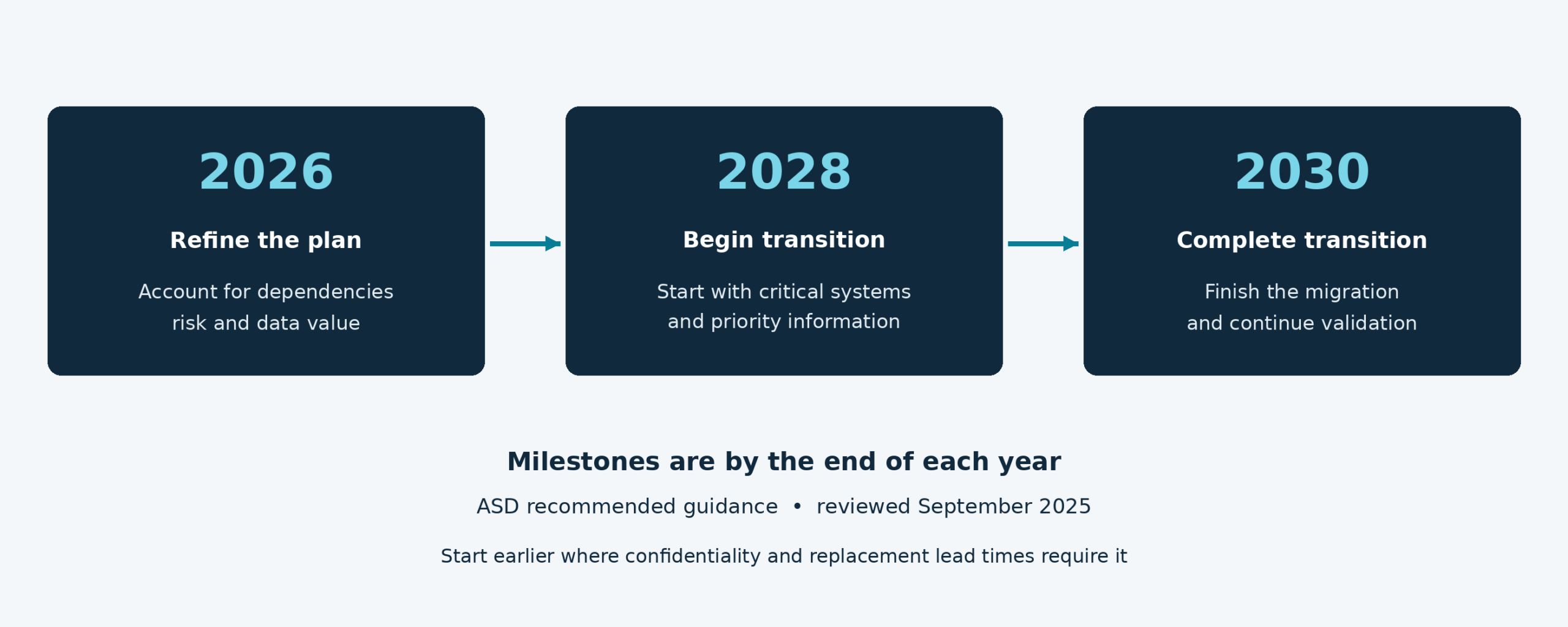
ASD’s established guidance recommends a refined plan by the end of 2026, transition commencing with priority systems by the end of 2028 and completion by the end of 2030. Those are recommended milestones, not blanket statutory deadlines for every Australian business.
Use ASD’s vendor questions to make procurement concrete. Seek a versioned commitment, dependency list, testing support and clear costs. Our preferred evidence is a tested path for a critical service, with residual limitations recorded, rather than a portfolio-wide quantum-ready label.
Quantum computers remain difficult to build. Apparently, so does a complete inventory of what we encrypt.
13 | Make this week change next week
A small number of owned actions is more useful than an unowned catalogue of concerns.
| Proposed owner | Action | Evidence to bring back |
|---|---|---|
| Technology and security operations | Recheck relevant NetScaler, Atlassian and FortiGate exposure. | Running build and configuration, investigation result, credential revocation and rotation, and service validation. |
| Identity and engineering | Review privileged automation and connected applications. | Workflow approval test, scoped credentials, reviewed consent and a demonstrated revocation path. |
| Business owner and AI lead | Select one consequential agent workflow for evaluation. | Defined delegation, allowed and denied action tests, independent record of decisions and results. |
| Platform and procurement | Start or refine the PQC transition programme. | Critical dependency inventory, supplier commitments, funding estimate and a bounded interoperability test. |
| Executive sponsor | Review the few unresolved risks that require authority or funding. | Named decision, accountable owner, agreed date and an explanation of remaining exposure. |
Our continuous compliance position
At Gadget Access, our position is that compliance should describe an operating condition. A control owner needs evidence that a change took effect, that the protected service still works and that exceptions remain understood. A quarterly slide can summarise that evidence; it cannot create it.
We advocate the same principle for CiBRAI. AI-assisted analysis should support investigation and coordinated response. Consequential actions need bounded authority and independently reviewable records. Customers should assess these requirements against the actual deployment and agreed service.
The buying question we recommend is concrete: show one incident from detection through investigation and authorised response to verified recovery. Show who can stop the automation and how the evidence is retained. Then repeat the demonstration for a failure case.
Next week’s discussion should test these controls under pressure, when a response cannot wait for the governance meeting.
Andrew Curtis | Gadget Access and CiBRAI · Connect on LinkedIn
Research desk | Sources and evidence
Publication dates are distinguished from incident dates and study periods. Vendor claims remain attributed; recommendations and conceptual diagrams are Gadget Access editorial analysis. Image credit: original AI-generated conceptual editorial artwork commissioned for this edition. Images are illustrations, not photographs of reported incidents or named facilities.
- ASD ACSC: Chinese government linked cyber threat actors combine automated and hands on hacking tools (9 Oct 2026)
- US DOJ: Seizure of vulnerability scanning and spear phishing tools (8 Oct 2026)
- Citrix: NetScaler security bulletin CTX697191, CVE-2026-107406 (8 Oct 2026)
- ASD ACSC: Critical vulnerabilities in Citrix NetScaler products (updated 9 Oct 2026)
- Atlassian: Arbitrary file access vulnerability CVE-2026-21589 (5 Oct 2026)
- FBI and US Secret Service: FortiBleed operations and reports of lockouts (6 Oct 2026)
- Google Chrome Security: Response to country code registry hijacks (6 Oct 2026)
- Socket: GhostAction expands to cloud credentials (9 Oct 2026)
- StepSecurity: GhostAction returns with malicious security audit workflows (9 Oct 2026)
- NSA: Zero Trust guidance for operational technology systems (8 Oct 2026)
- ACNC: Take a second and stay cyber secure in October (6 Oct 2026)
- Google Research: Open and emergent problems in agentic privacy and security (5 Oct 2026)
- Microsoft: Execution Containers and policy driven containment for agents (7 Oct 2026)
- Anthropic: Expanded Cyber Verification Program (6 Oct 2026)
- Anthropic: Introducing the Anthropic Cyber Mission (8 Oct 2026)
- Anthropic Frontier Red Team: Opt in vulnerability finding service for open source (8 Oct 2026)
- OpenAI: Advancing computer use with Ironclad (6 Oct 2026)
- PM&C: Building AI infrastructure that works for Australia (consultation closed 9 Oct 2026)
- DARPA: Four more teams enter the Quantum Benchmarking Initiative final stage (7 Oct 2026)
- Diraq: Advances to the final stage of the DARPA initiative (8 Oct 2026)
- Xanadu: Strategic manufacturing partnership with GlobalFoundries (6 Oct 2026)
- US GAO: Federal actions needed to prepare for the quantum cyber threat (public release 6 Oct 2026)
- US GAO: Full report and audit methodology (audit Feb 2024 to Sep 2025)
- Europol: Early action to protect cryptocurrencies and sensitive data (7 Oct 2026)
- Jain, Wills and Singh: Symmetry and AI assisted discovery of magic state factories (preprint, 5 Oct 2026)
- Yadavalli and colleagues: Protecting quantum computers against untrusted users (preprint, 5 Oct 2026)
- ASD ACSC: Planning for post quantum cryptography (background; reviewed Sep 2025)
- ASD ACSC: Post quantum questions to ask your vendors (16 Jul 2026; background)
- ASD ACSC: Essential Eight maturity model (background)
About this briefing
The Cyber Brief is a weekly read for senior security leaders, published by GadgetAccess in partnership with CiBRAI. Subscribe to the weekly briefing to get the next edition before it lands here.
If any of this week’s signals raised questions for your environment, we offer a complimentary 30 minute discovery call. No pitch, no follow up unless you ask. Book a discovery call.
This publication provides general information and editorial analysis. It does not constitute legal, technical, investment, insurance or incident-specific advice. Product and company names remain the property of their respective owners. © 2026 Gadget Access Pty Ltd and CiBRAI Pty Ltd.