

What’s New In Cybersecurity? | A five-minute CISO read | Week ending 14 June 2026
Welcome to Gadget Cyber News Weekly, the five-minute briefing for CISOs who like their cyber news practical, current and only lightly sprinkled with existential dread. This week’s theme is tempo. Vulnerabilities are being found faster, attackers are operationalising faster, and boards are increasingly asking whether security teams can prove action in days rather than weeks. The cyber weather report is therefore hot, patchy, and with a 90% chance of someone asking whether Chrome has actually restarted.
Briefing at a glance
| Signal | Why CISOs should care | Executive move this week |
| Patch tempo jumped | CISA’s new risk-based directive and Microsoft’s record-sized Patch Tuesday point to a shorter tolerance for slow remediation. | Recast high-risk patch SLAs around exposure, exploitability and business criticality, not generic CVSS queues. |
| Edge access stayed hot | Check Point confirmed active exploitation of a VPN authentication bypass in deprecated IKEv1 configurations. | Verify VPN/firewall/SD-WAN inventory, exposed management planes, emergency hotfix status and post-compromise log review. |
| Browser risk became board-visible | Google confirmed in-the-wild exploitation of Chrome CVE-2026-11645 and CISA added it to the KEV catalog. | Report browser update and restart compliance as an endpoint control, not a casual IT hygiene item. |
| SaaS joined the front line | ServiceNow applied hosted customer updates after a flaw could allow unintended access and table queries in some instances. | Review SaaS admin visibility, notification workflows, API exposure, logging retention and tenant-level access reviews. |
| The software factory got weird | The Miasma campaign targeted AI coding tools and IDE behaviours rather than only package installation paths. | Treat developer workstations, repo configs and AI assistant permissions as production-adjacent assets. |
| Australia leaned into resilience | The Australian Government and Microsoft announced a digital resilience MOU; a Mackay Sugar incident showed operational impact at home. | Connect cyber, cloud, AI and critical infrastructure resilience into one board narrative. |
What happened in the last week
- The largest story was not a single breach; it was the compression of the defence cycle. On 10 June, Reuters reported that CISA’s new directive requires U.S. civilian agencies to fix, disable or remove the most serious exposed vulnerabilities within three calendar days, with longer windows for lower-risk issues (Satter, 2026). Even outside the U.S. federal context, this is a market signal: the patch conversation is moving from monthly cadence to risk-clock management. Calendar-based vulnerability management has not died, but it has been asked to stand at the back of the room and think about what it has done.
- Microsoft then dropped a June Patch Tuesday shaped like a meteor. CrowdStrike’s analysis counted 206 vulnerabilities, including three publicly disclosed zero-days and 37 Critical vulnerabilities (CrowdStrike Falcon Exposure Management Team, 2026). Krebs on Security also described it as a record Patch Tuesday, noting that public exploit code existed for at least three weaknesses and that AI-assisted bug finding may make unusually large update cycles feel less unusual (Krebs, 2026a).
- The browser story was just as board-relevant. Google’s 8 June Stable Channel update for Chrome included 74 security fixes and confirmed that an exploit for CVE-2026-11645 existed in the wild (Google Chrome Releases, 2026). NVD describes the flaw as an out-of-bounds read and write in V8 before Chrome 149.0.7827.103 that could allow arbitrary code execution inside the sandbox via a crafted HTML page; the entry also records CISA KEV treatment and a 23 June 2026 remediation due date for federal systems (National Vulnerability Database, 2026). In plain English: update is good, restart is better, proof is best.
- At the network edge, Check Point confirmed active exploitation of CVE-2026-50751, a critical authentication bypass affecting Remote Access VPN and Mobile Access deployments configured with deprecated IKEv1. Check Point said exploitation had been seen against a few dozen targeted organisations globally and that one case involved post-compromise activity associated with a Qilin ransomware affiliate (Check Point Research, 2026). Any internet-facing access control plane that still feels ‘temporary’ should now be treated as a suspiciously permanent problem.
- SaaS also had a visible week. The Hacker News reported that ServiceNow applied a 5 June security update to hosted customer instances after an issue could, in certain circumstances, allow an unauthenticated user greater access than intended; ServiceNow also observed successful queries of instance tables against a subset of customers (Lakshmanan, 2026). That is the quiet part of modern exposure management: tenant configuration, platform logging and vendor notifications now sit beside firewalls and EDR in the CISO’s morning dashboard.
- The software factory received its own plot twist. StepSecurity reported that the Miasma worm campaign reached Microsoft’s Azure GitHub organisations on 5 June, with GitHub disabling 73 repositories after a malicious commit to Azure/durabletask used a compromised contributor account. The attack planted configuration files designed to execute a credential-harvesting payload when a developer opened the repository in tools such as Claude Code, Gemini CLI, Cursor or VS Code (Kurmi, 2026). The old question was, ‘What happens when a package installs?’ The new question is, ‘What happens when a developer simply opens the folder?’
What did we learn
The first lesson is that AI changes economics before it changes physics. ACSC’s recent frontier AI update warned that models can accelerate vulnerability discovery and exploitation, while also noting that active defenders, EDR, segmentation and other existing controls still create friction (Australian Signals Directorate’s Australian Cyber Security Centre [ASD’s ACSC], 2026b). In other words, the robots are not magic. They are very fast interns with questionable judgment and excellent throughput.
The second lesson is that defensive AI is becoming normal, not experimental. Darktrace’s 2026 report found that 87% of security leaders say AI significantly increases cyber threats requiring attention, 92% are concerned about AI agents across the workforce, and 96% say defensive AI improves security capabilities (Darktrace, 2026). The governance challenge is to let AI reduce noise, speed investigation and improve coverage without quietly becoming a new privileged identity, a new data sink or a new way to automate poor decisions at enterprise speed.
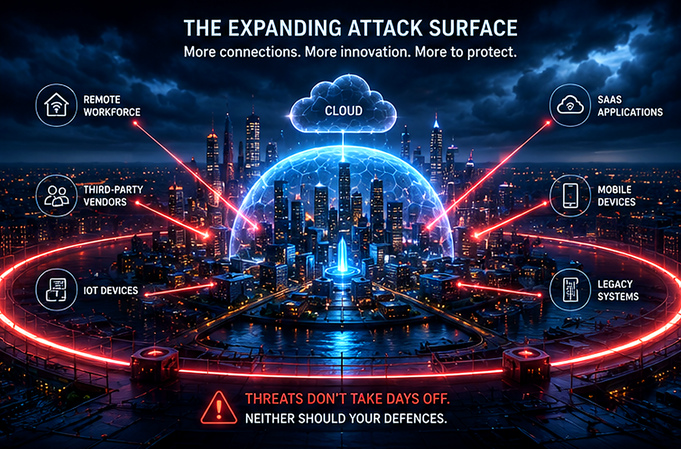
The third lesson is architectural. This week’s incidents span VPNs, browsers, SaaS platforms, GitHub repositories, coding assistants, IT helpdesk impersonation and local Australian operational disruption. The common theme is not a single control failure. It is that security teams must now prove control across identity, exposure, recovery and vendor dependencies. The castle has become a co-working space; the drawbridge is an API.
What to watch out for
| Watch item | CISO question for Monday | Evidence worth taking to the board |
| Internet-facing access systems | Which VPNs, firewalls, SD-WAN managers and remote access systems are exposed, end-of-life or using deprecated protocols? | Inventory extract, exposure scan, hotfix status, and evidence of log review back to earliest plausible exploitation. |
| Browser restart debt | How many endpoints have downloaded but not activated the current browser fix because the process is still running? | Browser version telemetry, restart compliance trend, and exception list by business unit. |
| SaaS tenant exposure | Which SaaS platforms hold sensitive records, and do we receive actionable vendor security notices fast enough? | Admin role review, API access register, audit-log retention, and incident notification runbook. |
| Developer workstations and AI tools | What can repo configuration files, IDE plugins and AI coding agents execute automatically or influence indirectly? | Approved tool list, secret scanning results, branch protections, and sandboxing or policy controls for AI assistants. |
| Social engineering plus physical access | Would reception, facilities and helpdesk staff stop a fake IT technician with a convincing script? | Visitor verification workflow, call-back scripts, USB policy enforcement, and tabletop exercise results. |
Trending issues
Patch windows are shrinking faster than meeting agendas
The practical takeaway from CISA’s directive is not that every organisation can or should copy a three-day rule wholesale. It is that boards and regulators will increasingly expect a visible triage method for the vulnerabilities that combine public exposure, known exploitation, automation potential and meaningful business impact. A risk-based patch program without evidence is just a spreadsheet with ambition.
AI agents are entering the workforce through the side door
ACSC’s agentic AI guidance warns that autonomous, interconnected AI systems introduce distinct governance, accountability and security risks, and recommends incremental adoption, strict privilege controls, monitoring, strong identity and human oversight (ASD’s ACSC, 2026a). That maps directly to the week’s developer-tool supply-chain lesson: AI assistants are not only productivity tools; they are execution environments, workflow influencers and potential secret magnets.
SaaS is now a first-class incident-response surface
ServiceNow’s hosted-instance update is a reminder that SaaS platforms hold the records, workflows and privileged operational context attackers love. CISOs should expect more incidents where the first useful evidence is not in a firewall, but in tenant audit logs, vendor bulletins, identity events and API activity. The glamorous part of SaaS security remains very small; the log-retention invoices remain very real.
Latest in People
Google Cloud’s Mandiant and Threat Intelligence teams reported an ongoing campaign by UNC3753, also tracked as Luna Moth, Chatty Spider and Silent Ransom Group, targeting dozens of U.S. professional, legal and financial services organisations between January and May 2026. The group uses invoice pretexts, vishing, screen-sharing sessions and legitimate remote monitoring tools, and Google noted possible instances of in-person access by individuals posing as IT technicians (Reams et al., 2026). For CISOs, the people lesson is simple: security awareness is no longer a poster; it is a verified workflow. Reception, facilities, executive assistants and helpdesk staff are part of the control plane. Yes, the visitor badge is now a cyber control. It has been waiting years for this promotion.
The ransomware labour market is also becoming more aggressive. Krebs reported that The Gentlemen has emerged as the second most active ransomware group by victim count, promoting a 90/10 affiliate split and targeting internet-facing VPNs and firewalls as entry points before moving quickly to encrypt networks (Krebs, 2026b). When affiliate economics improve, defenders should assume campaign volume, skill and speed will follow.
Latest in Process
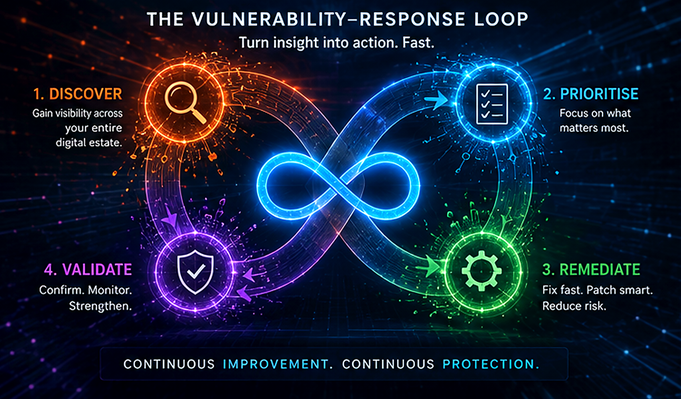
The process upgrade of the week is risk-based vulnerability response with forensic triage built in. A practical CISO model should place vulnerabilities into fast lanes when they are internet-facing, in a known-exploited list, easily automatable, capable of granting meaningful control or attached to crown-jewel systems. The remediation action does not always have to be a patch. It can be isolation, removal from the internet, feature disablement, compensating controls or vendor mitigation. What matters is that the decision is fast, owned and evidenced.
The second process upgrade is AI adoption governance. ACSC’s ‘Using AI to strengthen cyber defence’ guidance says AI can strengthen defence when used securely, but can also amplify risk and expand the attack surface when used carelessly (ASD’s ACSC, 2026c). CISOs should ask for an inventory of AI use cases, data flows, model access, agent permissions and human approval points. That inventory will not be perfect at first. Neither was the first cloud inventory, and look how emotionally character-building that became.
Latest in Technology
The technology theme is convergence. Browser exploitation, Copilot-related cloud fixes, AI coding agent abuse, SaaS access issues and VPN exploitation all sit somewhere between identity, endpoint, cloud and application security. Tool categories are increasingly less useful than control outcomes: discover the asset, understand the exposure, constrain the identity, monitor the behaviour and prove the fix.
Darktrace’s finding that 77% of security stacks now use generative AI suggests the market has moved past the question of whether AI will enter the SOC (Darktrace, 2026). The better question is whether the SOC can explain where AI is used, what data it sees, what actions it can trigger and how humans override it. Defensive AI should be treated like a high-performing analyst with a powerful keyboard: valuable, supervised and never given production privileges just because it sounds confident.
Compliance news
CISA’s BOD 26-04 is formally aimed at U.S. federal civilian agencies, but the compliance signal is broader. Reuters reported that the most serious vulnerabilities must be addressed within three calendar days, while lower-risk issues can have longer deadlines (Satter, 2026). The likely downstream effect is pressure on suppliers, managed-service providers, insurers and boards to explain why critical exposed risk still sits in a queue measured in weeks. A good policy response is not ‘patch everything instantly’; it is ‘define the risk threshold, prove the fast lane, and document accepted residual risk.’
In Australia, the new Microsoft-Government digital resilience MOU matters because it connects secure cloud, cybersecurity, AI infrastructure, data-centre resilience, threat information sharing, incident response and critical infrastructure policy in one cooperation framework (Microsoft Source Asia, 2026; Tarre, 2026). For regulated sectors, especially critical infrastructure and financial services, the direction of travel is clear: cyber resilience is being treated as national resilience, not simply an IT control domain.
Australia
Australia’s headline this week was the digital resilience partnership signed in Canberra by Minister for Home Affairs and Cyber Security Tony Burke and Microsoft President of Global Affairs Lisa Monaco. The MOU outlines cooperation on secure cloud infrastructure, cybersecurity, AI and critical infrastructure protection, with focus areas including critical connectivity networks, data-centre infrastructure, threat information sharing and secure AI adoption in government (Microsoft Source Asia, 2026; Tarre, 2026). For local CISOs, this is a cue to align internal strategy language with resilience: not just prevention, but trusted recovery, sovereign control, service continuity and third-party dependency management.
The operational side of Australian cyber risk also showed up in Queensland. ABC reported that a cyber security incident affecting Mackay Sugar operations shut down sugar milling and cane haulage across the Farleigh and Racecourse mills, with the company focused on safety and business continuity while recovery activities continued (Mitchell, 2026). This is a useful board example because it makes cyber tangible: missed production windows, disrupted logistics, fallback processes and stakeholder communications. It is hard to explain ransomware dwell time over lunch; it is easier to explain stalled cane trains.
ACSC’s recent AI guidance gives Australian organisations a practical anchor: use AI to strengthen defence, adopt agentic systems cautiously, keep least privilege and monitoring in place, and preserve human oversight for meaningful decisions (ASD’s ACSC, 2026a, 2026c). That is a sensible local posture for the next quarter: faster detection, tighter exposure management, and no unsupervised AI agent wandering through production like it owns the place.
This week’s board sentence
The cyber risk conversation has moved from “Are we patched?” to “Can we identify, prioritise, fix and prove the right controls within days – while governing AI, SaaS and suppliers that keep creating new doors?”
References
Australian Broadcasting Corporation. (2026, June 10). Cyber attack shuts down two Mackay Sugar mills. https://www.abc.net.au/news/2026-06-10/cyber-attack-shuts-down-north-queensland-sugar-mills/106780304
Australian Signals Directorate’s Australian Cyber Security Centre. (2026a, May 1). New joint guidance provides mitigations for careful adoption of agentic AI services. https://www.cyber.gov.au/about-us/view-all-content/news/new-joint-guidance-provides-mitigations-for-cautious-adoption-of-agentic-ai
Australian Signals Directorate’s Australian Cyber Security Centre. (2026b, May 8). Frontier AI models and their impact on cyber security. https://www.cyber.gov.au/about-us/view-all-content/news/frontier-models-and-their-impact-on-cyber-security-update
Australian Signals Directorate’s Australian Cyber Security Centre. (2026c, May 27). Using AI to strengthen cyber defence. https://www.cyber.gov.au/about-us/view-all-content/news/using-ai-to-strengthen-cyber-defence
Check Point Research. (2026, June 8). Security advisory – action required – active exploitation of Check Point VPN authentication bypass (CVE-2026-50751). Check Point Software. https://blog.checkpoint.com/security/check-point-releases-important-hotfix-for-vulnerabilities-in-deprecated-ikev1-vpn-protocol/
CrowdStrike Falcon Exposure Management Team. (2026, June 9). June 2026 Patch Tuesday: Microsoft patches 206 vulnerabilities including three publicly disclosed zero-days. CrowdStrike. https://www.crowdstrike.com/en-us/blog/patch-tuesday-analysis-june-2026/
Cybersecurity and Infrastructure Security Agency. (2026, June 10). BOD 26-04: Prioritizing security updates based on risk. https://www.cisa.gov/news-events/directives/bod-26-04-prioritizing-security-updates-based-risk
Darktrace. (2026). The state of AI cybersecurity 2026. https://www.darktrace.com/resource/the-state-of-ai-cybersecurity-2026
Google Chrome Releases. (2026, June 8). Stable Channel Update for Desktop. https://chromereleases.googleblog.com/2026/06/stable-channel-update-for-desktop_0153744567.html
Krebs, B. (2026a, June 9). A record-breaking Patch Tuesday for June 2026. Krebs on Security. https://krebsonsecurity.com/2026/06/a-record-breaking-patch-tuesday-for-june-2026/
Krebs, B. (2026b, June 10). Who runs the ransomware group ‘The Gentlemen?’ Krebs on Security. https://krebsonsecurity.com/2026/06/who-runs-the-ransomware-group-the-gentlemen/
Kurmi, A. (2026, June 5). Miasma worm hits Microsoft again: Azure Functions Action and 72 other repositories disabled after supply chain attack targeting AI coding agents. StepSecurity. https://www.stepsecurity.io/blog/miasma-worm-hits-microsoft-again-azure-functions-action-and-72-other-repositories-disabled-after-supply-chain-attack-targeting-ai-coding-agents
Lakshmanan, R. (2026, June 10). ServiceNow flaw exploited to gain unauthorized access to customer instances. The Hacker News. https://thehackernews.com/2026/06/servicenow-flaw-exploited-to-gain.html
Microsoft Source Asia. (2026, June 9). Microsoft and Australian Government deepen collaboration to strengthen nation’s digital and economic resilience. https://news.microsoft.com/source/asia/2026/06/09/microsoft-au-government-resiliency-mou/
National Vulnerability Database. (2026). CVE-2026-11645 detail. National Institute of Standards and Technology. https://nvd.nist.gov/vuln/detail/CVE-2026-11645
Reams, C., Ahmed, T., Knapp, K., Frazer, A., & McLellan, T. (2026, June 6). Seeking counsel: Ongoing targeted campaign against U.S. law firms. Google Cloud Threat Intelligence. https://cloud.google.com/blog/topics/threat-intelligence/targeted-campaign-us-law-firms
Satter, R. (2026, June 10). US shortens cyber fix window to three days as AI threats rise. Reuters. https://www.reuters.com/legal/litigation/us-shortens-cyber-fix-window-three-days-ai-threats-rise-2026-06-10/
Tarre, M. (2026, June 11). Microsoft & Australia sign digital resilience deal. IT Brief Australia. https://itbrief.com.au/story/microsoft-australia-sign-digital-resilience-dealEditorial note: This draft is intended for CISO-facing thought leadership and should be reviewed against internal legal, brand and disclosure policies